

Introduction
Choosing the right preschool is about more than colorful classrooms, modern facilities, or a long list of worksheets. For young children, the everyday learning experience matters just as much. Preschool is an important stage for developing foundational skills, and the right activities can make learning enjoyable, meaningful, and engaging.
At this age, children learn best when they can explore, play, interact, ask questions, and learn through hands-on experiences. Activities such as painting, storytelling, outdoor exploration, music, sensory play, and simple problem-solving challenges can help children develop creativity, communication, confidence, coordination, and social skills.
However, not every preschool offers the same variety or quality of learning experiences. Some may focus heavily on worksheets and structured classroom work, while others create opportunities for children to learn through play and active participation.
That is why parents should look beyond the facilities when comparing preschools. Instead of asking only, “What does the preschool have?”, ask, “What does my child get to experience every day?”
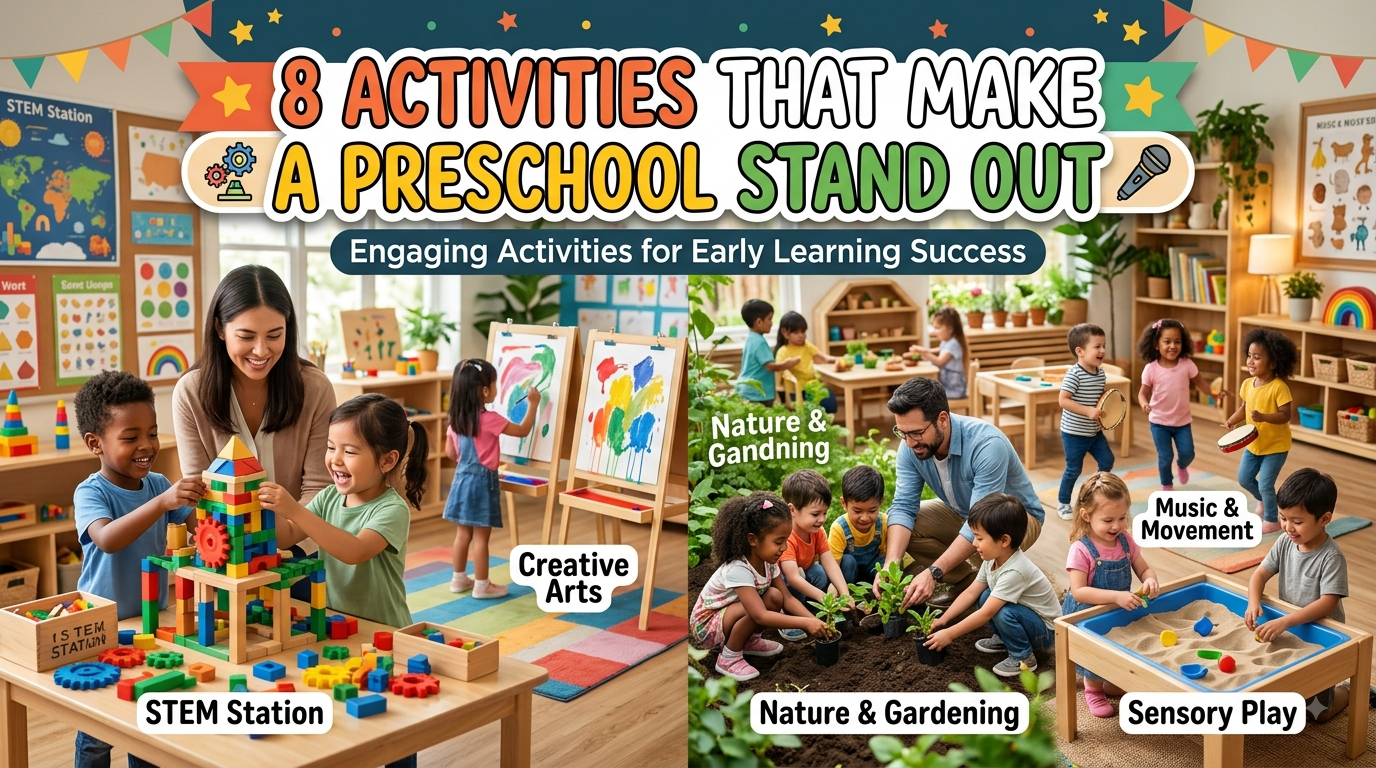
In this guide, we explore 8 activities that can make a preschool stand out and explain how each one can contribute to a child’s overall development.
What Makes a Preschool Stand Out?
Briefly explain the characteristics parents should look for.
- Age-appropriate learning
- Play-based education
- Hands-on experiences
- Opportunities for creativity
- Social interaction
- Physical activity
- Emotional development
- Individual attention
- A safe and stimulating environment
Transition: Activities should not simply keep children busy—they should have a clear developmental purpose.
1. Creative Art and Craft Activities
What to include:
- Drawing and colouring
- Painting
- Clay modelling
- Paper crafts
- Collage making
- Finger painting
Developmental benefits:
- Creativity
- Fine motor skills
- Hand-eye coordination
- Self-expression
- Concentration
Parent takeaway:
A preschool that regularly provides open-ended creative activities gives children opportunities to express ideas rather than simply follow instructions.
2. Sensory Play Activities
Explain how sensory play allows children to explore materials through touch, sight, sound, and movement.
Examples:
- Sand play
- Water play
- Play dough
- Texture boards
- Rice or grain sensory bins
- Nature-based sensory activities
Benefits:
- Sensory exploration
- Curiosity
- Cognitive development
- Fine motor development
- Problem-solving
Naturally include phrases such as sensory activities for preschoolers and preschool learning activities.
3. Storytelling and Role-Play
Explain how storytelling can turn early learning into an interactive experience.
Examples:
- Story circles
- Puppet shows
- Dress-up activities
- Pretend shops
- Community helper role-play
- Character-based storytelling
Benefits:
- Language development
- Vocabulary
- Communication
- Imagination
- Confidence
- Social skills
Parent takeaway:
Look for preschools where children are encouraged to participate in stories rather than only listen to them.
4. Music, Dance, and Movement
Discuss the importance of movement in early childhood.
Activities:
- Action songs
- Dance sessions
- Musical games
- Rhythm activities
- Instruments for children
- Freeze dance
Benefits:
- Gross motor skills
- Rhythm and coordination
- Listening skills
- Confidence
- Self-expression
Key point: Preschool activities should include opportunities for children to move, not keep them seated for long periods.
5. Outdoor and Nature-Based Activities
Explain why outdoor experiences are an important part of a well-rounded preschool program.
Examples:
- Gardening
- Nature walks
- Outdoor obstacle courses
- Planting seeds
- Leaf and flower exploration
- Sand and mud play
- Outdoor observation activities
Benefits:
- Physical development
- Curiosity
- Observation skills
- Appreciation of nature
- Teamwork
- Problem-solving
Parent takeaway:
Ask whether outdoor play is a regular part of the preschool routine or only an occasional activity.
6. Early STEM and Problem-Solving Activities
Introduce STEM concepts in an age-appropriate, play-based way.
Examples:
- Building blocks
- Simple experiments
- Sorting and counting games
- Pattern activities
- Shape exploration
- Building challenges
- Sink-or-float experiments
Benefits:
- Logical thinking
- Problem-solving
- Early mathematical concepts
- Observation
- Curiosity
- Critical thinking
Important: Emphasize that preschool STEM should be playful and hands-on rather than overly academic.
7. Social-Emotional Learning Activities
Explain that preschool education should support emotional and social development alongside academics.
Activities:
- Circle-time conversations
- Emotion cards
- Sharing games
- Team activities
- Friendship exercises
- Helping tasks
- Gratitude activities
Benefits:
- Emotional awareness
- Empathy
- Cooperation
- Communication
- Self-confidence
- Conflict-resolution skills
Parent takeaway:
A standout preschool helps children understand not only numbers and letters but also how to interact with others and manage everyday emotions.
8. Cultural, Community, and Special-Day Activities
Explain how celebrations and community-focused activities can broaden children’s understanding of the world.
Examples:
- Cultural celebrations
- Community helper days
- Food-related activities
- Dress-up days
- Family participation events
- Storytelling about different cultures
- Special-day themed activities
Benefits:
- Cultural awareness
- Social understanding
- Communication
- Participation
- Curiosity
- Sense of community
Tip: Focus on meaningful learning rather than simply decorating the classroom for special occasions.
How These Activities Support Holistic Child Development
Bring the eight activities together and explain how they support multiple developmental areas.
Suggested framework:
|
Activity |
Key Skills Developed |
| Art & Craft |
Creativity, fine motor skills |
|
Sensory Play |
Exploration, cognition |
| Storytelling & Role-Play |
Language, imagination |
|
Music & Dance |
Coordination, confidence |
| Outdoor Activities |
Physical skills, curiosity |
|
STEM Activities |
Logic, problem-solving |
| Social-Emotional Activities |
Empathy, communication |
|
Cultural Activities |
Awareness, participation |
Emphasize that the best preschool programs create a balance between academic readiness, physical development, creativity, communication, and emotional growth.
What Parents Should Look for When Visiting a Preschool
Provide a practical checklist parents can use during a school visit.
Questions to ask:
- What activities are included in the daily routine?
- How often do children participate in outdoor play?
- Are art and creative activities part of the regular curriculum?
- Does the preschool use play-based learning?
- How are social and emotional skills developed?
- Are activities age-appropriate?
- Do children get opportunities for free exploration?
- How does the school encourage parent participation?
Why Activity-Based Learning Matters in Preschool
Explain that activities should connect fun with purposeful learning.
Discuss:
- Children learn by doing.
- Hands-on experiences can make concepts easier to understand.
- Activities encourage curiosity and participation.
- Play can support cognitive, social, emotional, and physical development.
- A balanced preschool experience prepares children for the next stage of education without making early learning unnecessarily stressful.
How to Tell If a Preschool’s Activities Are Truly Meaningful
This section adds differentiation and demonstrates expertise.
Look for:
- Activities appropriate for children’s age and abilities
- Children actively participating
- Teachers guiding rather than doing everything for children
- Opportunities for exploration
- Variety throughout the week
- Activities connected to learning objectives
- Balance between structured and free play
- Individual as well as group activities
Avoid focusing only on:
- Number of events
- Fancy classroom decorations
- Occasional theme days
- Worksheets and rote learning
- Activities designed mainly for photographs
Frequently Asked Questions
What activities are important in preschool?
Discuss creative, sensory, physical, language, social-emotional, outdoor, and problem-solving activities.
What makes a preschool stand out?
Explain that a strong preschool combines qualified teachers, a safe environment, age-appropriate curriculum, meaningful activities, play-based learning, and individual attention.
How do preschool activities help child development?
Explain how activities can support cognitive, physical, social, emotional, language, and creative development.
What are the best learning activities for preschoolers?
Mention hands-on activities such as storytelling, art, sensory play, building, music, outdoor exploration, and simple STEM activities.
Should preschool activities be academic?
Clarify that preschool activities should build foundational skills in an engaging, age-appropriate way rather than rely heavily on formal academics.
Conclusion
A preschool stands out for much more than its classrooms, facilities, or infrastructure. What truly makes a difference is the quality of experiences children receive every day. Meaningful activities give children opportunities to explore, create, communicate, solve problems, build confidence, and develop essential social and emotional skills.
From creative arts and sensory play to storytelling, music, outdoor exploration, early STEM, social-emotional learning, and cultural activities, each experience can contribute to a child’s overall development. The best preschool activities are not simply designed to keep children engaged—they make learning enjoyable, purposeful, and age-appropriate.
When comparing preschools, look beyond the brochure. Ask about the experiences your child will have every day. Choose a preschool where learning, creativity, play, exploration, and development go hand in hand, creating a positive foundation for your child’s future learning journey.
How Grow Inn Steps Makes Preschool Learning More Engaging
At Grow Inn Steps, preschool learning goes beyond traditional classroom teaching. The approach focuses on creating a stimulating, interactive, and secure environment where children can learn through play, exploration, and hands-on experiences. Its child-centric methodology combines Montessori, IB, and Playway approaches to encourage creativity, independence, problem-solving, and active participation.
This philosophy can be seen in the variety of experiences offered to children. From art and craft, storytelling, music and dance, and outdoor play to sensory exploration and simple science-based activities, children get opportunities to learn while doing. Grow Inn Steps also provides creative spaces, reading corners, dedicated play areas, and outdoor environments designed to encourage discovery and movement.
Why These Activities Matter at Grow Inn Steps
The activities are designed to support different areas of early childhood development. Creative activities can encourage self-expression and fine motor development, while storytelling and music can support communication and confidence. Outdoor play provides opportunities for physical development, and hands-on problem-solving activities encourage children to think, explore, and make decisions independently.
Grow Inn Steps also emphasizes individual attention and holistic development, recognizing that every child learns and develops at their own pace. Its programs are designed around children’s developmental needs, with activities and learning experiences adapted for different age groups.
For parents comparing preschools, this activity-based approach is an important factor to consider. A preschool should provide more than academic preparation—it should give children opportunities to play, create, communicate, explore, collaborate, and build confidence.
Grow Inn Steps aims to make these everyday experiences a meaningful part of a child’s early learning journey, helping children build a strong foundation for future learning while enjoying the process along the way.
