

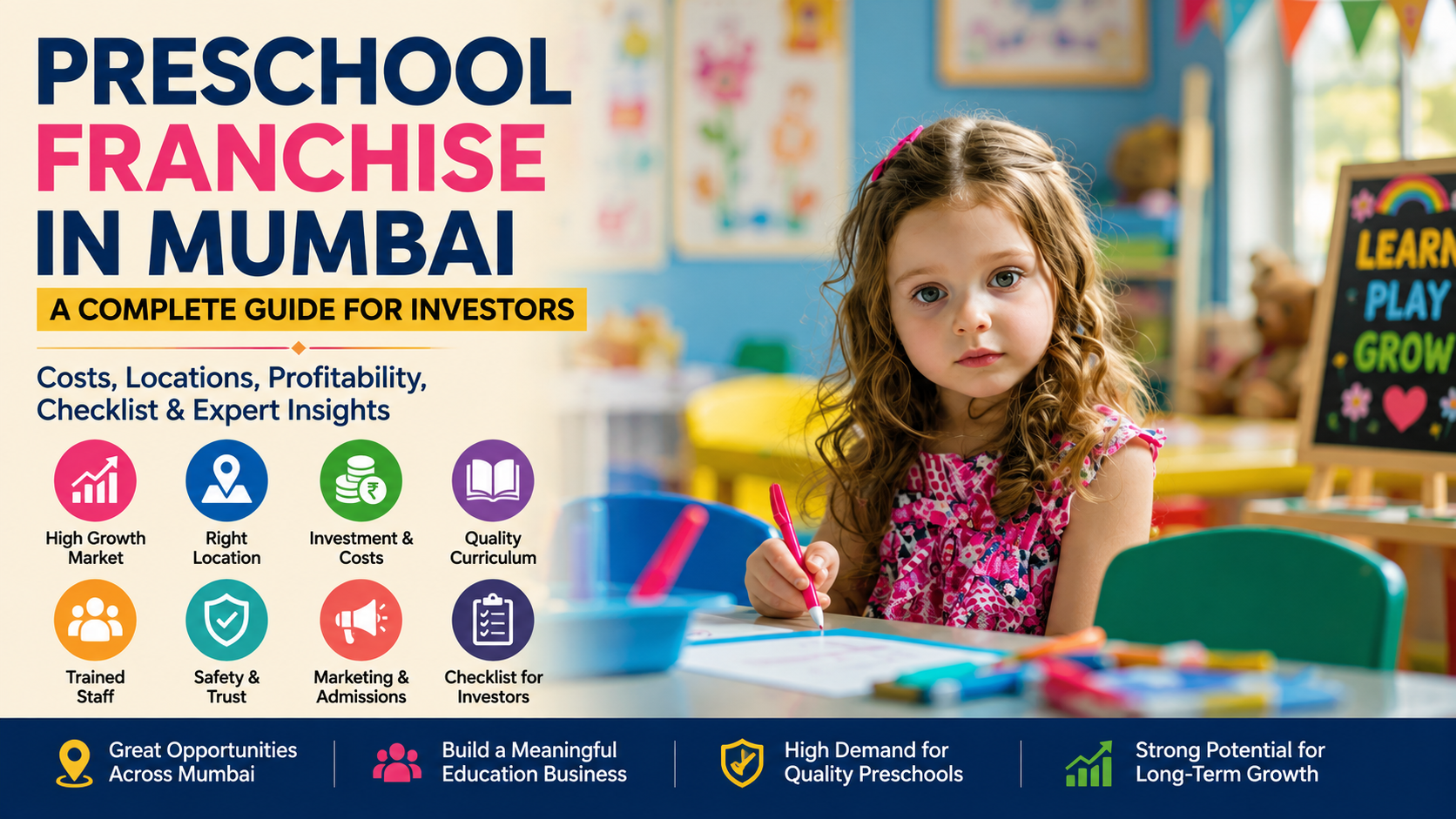
Introduction
Mumbai is one of India’s most active metropolitan markets, offering significant opportunities for entrepreneurs interested in the early childhood education sector. With increasing awareness among parents about the importance of early learning, preschool education is becoming an essential part of a child’s early development. Parents are increasingly looking for preschools that provide a combination of quality education, safety, engaging activities, and a supportive learning environment.
The demand for preschool education is particularly relevant among working and dual-income families in Mumbai. With busy professional schedules, many parents prefer trusted preschool and childcare options that provide convenient timings, structured learning, and a safe environment for their children. This creates opportunities for well-planned and professionally managed preschool centers in suitable residential and commercial catchment areas.
For entrepreneurs, a Preschool Franchise in Mumbai can be an attractive alternative to starting an independent preschool. Instead of developing a brand, curriculum, operating system, and marketing strategy entirely from the ground up, franchisees may receive support with branding, curriculum, teacher training, center setup, marketing, and day-to-day operations. However, the level of support, fees, investment requirements, and franchise terms vary from one brand to another, so careful research is essential.
Before investing, entrepreneurs should evaluate important factors such as preschool franchise cost in Mumbai, location, competition, student enrollment potential, staff expenses, franchise fees, ongoing operational costs, and expected profitability. A realistic financial plan is important because a preschool’s success depends not only on the initial investment but also on its ability to attract and retain students.
In this guide, we will explore Preschool Franchise in Mumbai: Investment, Cost, Profit & How to Start in 2026, including how to select the right location, compare franchise opportunities, plan the preschool setup, estimate operating costs, attract parents, calculate potential profitability, and understand the major risks involved.
Whether you are an education professional, first-time entrepreneur, or investor, this guide will help you make a more informed decision before investing in a preschool franchise in Mumbai.
Find more info: https://www.growinnsteps.com/top-10-preschool-franchises-in-mumbai-2025/
Why Invest in a Preschool Franchise in Mumbai?
Investing in a Preschool Franchise in Mumbai can be an attractive opportunity for entrepreneurs interested in the growing early childhood education sector. Mumbai has a large and diverse family population, strong demand for quality education, and many residential communities where parents actively seek convenient and trustworthy preschool options.
However, profitability should not be assumed simply because demand exists. The success of a preschool franchise depends on factors such as location, fees, enrollment, operating costs, competition, staff quality, and the level of support provided by the franchisor.
Growing Demand for Early Childhood Education
Parents are becoming increasingly aware of the role that early childhood education plays in a child’s overall development. Preschool is no longer viewed simply as a place for children to spend time before formal schooling. Parents often look for programs that support social, emotional, cognitive, language, and physical development through age-appropriate activities.
A well-planned preschool can provide children with a structured and child-friendly environment where they can learn through play, develop independence, interact with peers, and build foundational skills. This growing emphasis on early learning creates opportunities for quality preschool operators in Mumbai.
Large Urban Family Market
Mumbai and its surrounding urban areas offer a broad customer base for early childhood education businesses. Many residential neighborhoods contain apartment complexes, housing societies, and communities with young families who prefer schools located close to home.
For a preschool franchise, choosing the right catchment area is particularly important. A location within convenient reach of residential communities can make daily drop-offs easier for parents and potentially support stronger enrollment. Entrepreneurs should assess factors such as the number of young families, household demographics, local competition, accessibility, parking, and commercial rent before selecting a location.
Demand for Preschool + Daycare
For many working parents, finding both preschool education and reliable childcare is a major consideration. This makes a preschool-with-daycare model an option worth evaluating in Mumbai.
A center that offers extended daycare hours may be able to serve families who need childcare before or after regular preschool hours. Additional services such as holiday programs, summer camps, activity classes, and enrichment programs may also create supplementary revenue opportunities.
However, daycare requires additional staffing, safety procedures, space, and operating resources. Entrepreneurs should therefore evaluate the additional costs alongside the potential revenue before adding daycare services.
Established Franchise Models Reduce Startup Challenges
Starting an independent preschool requires an entrepreneur to develop a brand, curriculum, teaching methodology, operating procedures, marketing strategy, and staff-training system from the beginning. A franchise model can reduce some of these initial challenges by providing an established framework.
Depending on the franchise brand, support may include:
- Curriculum support: A structured curriculum and learning methodology can help standardize classroom delivery.
- Teacher training: Training programs can help teachers understand the curriculum, classroom management, and age-appropriate teaching practices.
- Branding: An established brand can provide marketing assets and a recognizable identity.
- Marketing support: Some franchisors provide digital marketing resources, admission campaigns, promotional materials, and launch support.
- Operational guidance: Franchisees may receive assistance with center setup, processes, technology, admissions, and ongoing operations.
Before signing an agreement, entrepreneurs should carefully compare what each franchise actually provides. The presence of a recognizable brand does not automatically guarantee admissions or profitability.
Overall, a Preschool Franchise in Mumbai can offer an organized entry point into the early childhood education sector. The strongest opportunity is likely to come from combining the right franchise model with a suitable location, realistic financial planning, high-quality teaching, strong safety standards, and effective local marketing.
Is a Preschool Franchise Profitable in Mumbai?
A Preschool Franchise in Mumbai can be a potentially profitable business opportunity, but profitability is not guaranteed. The financial performance of a preschool depends on several factors, including the location, operating expenses, student enrollment, fee structure, competition, and the quality of business management.
Mumbai offers a large market for early childhood education, but it is also a competitive and relatively high-cost city. Entrepreneurs should therefore avoid relying on generic ROI figures or franchise sales projections. Instead, profitability should be calculated using actual local costs and conservative enrollment assumptions.
Key Factors That Affect Preschool Franchise Profitability
- Location
Location is one of the most important factors affecting preschool profitability. A center located near residential communities with a strong concentration of families with young children may have greater enrollment potential. Accessibility, visibility, parking, safety, and proximity to competing preschools should also be considered.
- Rent
Mumbai property costs can significantly affect monthly expenses. A high-rent location may have strong demand, but excessive rent can reduce profitability if enrollment does not grow quickly enough. Entrepreneurs should compare expected revenue with rent and other operating expenses before finalizing a property.
- Initial Investment
The initial investment may include franchise fees, interiors, furniture, educational materials, safety equipment, technology, registration expenses, launch marketing, and working capital. A higher initial investment generally means that the business needs sufficient cash flow and enrollment to recover the investment over time.
- Number of Enrolled Students
Student enrollment is directly connected to revenue. A preschool with a large capacity but low enrollment may struggle to cover fixed expenses. Entrepreneurs should prepare different scenarios—for example, conservative, moderate, and optimistic enrollment levels—to understand how the business could perform under different conditions.
- Fee Structure
The monthly or annual fee charged to parents should reflect the local market, target audience, facilities, curriculum, and competing schools. Setting fees too low can limit revenue, while pricing significantly above comparable preschools may make admissions more difficult.
- Staff Costs
Teacher salaries, helpers, administrative staff, and daycare personnel can represent a significant portion of monthly expenses. Maintaining an appropriate staff-to-child ratio is important not only for operations but also for children’s safety and the quality of the learning environment.
- Marketing Expenses
A new preschool needs consistent marketing to build awareness and generate admissions. Expenses may include digital advertising, local SEO, social media marketing, open-house events, community promotions, and referral campaigns. Marketing costs should be included in the financial model rather than treated as an optional expense.
- Franchise and Royalty Fees
Depending on the franchise agreement, the operator may have to pay an initial franchise fee as well as recurring royalty, technology, marketing, or support fees. These costs can affect the center’s operating margins and should be clearly understood before signing the agreement.
- Occupancy Rate
The percentage of available seats that are actually filled is a critical profitability indicator. A preschool operating at 80–90% capacity will generally have a different financial outlook from one operating at 30–40% capacity, even if both charge the same fees.
- Daycare and Additional Programs
Daycare, summer camps, activity classes, extended-care programs, and enrichment activities can create additional revenue opportunities. However, they may also require additional staff, space, equipment, and operating expenses. Each additional service should therefore be evaluated based on its expected revenue and incremental cost.
How to Evaluate Preschool Franchise Profitability
Instead of asking only, “What is the ROI of a preschool franchise in Mumbai?”, prospective investors should build a complete financial model.
A simple starting point is:
Monthly Revenue = Number of Enrolled Students × Average Monthly Fee
Then subtract all recurring expenses, including:
- Rent
- Salaries
- Utilities
- Marketing
- Learning materials
- Maintenance
- Technology
- Franchise or royalty fees
- Daycare-related expenses
- Other administrative costs
The remaining amount represents the estimated operating surplus before deducting taxes, financing costs, depreciation, and other applicable expenses.
Use Conservative Enrollment Assumptions
One of the biggest mistakes prospective franchise owners can make is assuming that the preschool will reach full capacity immediately. New centers often need time to establish their reputation, generate parent inquiries, convert leads into admissions, and build enrollment.
A better approach is to create at least three financial scenarios:
|
Scenario |
Enrollment Assumption | Purpose |
| Conservative | Lower enrollment |
Tests downside risk |
|
Moderate |
Realistic enrollment | Main business projection |
| Optimistic | Higher enrollment |
Shows potential upside |
This approach provides a more realistic understanding of how the Preschool Franchise in Mumbai could perform under different circumstances.
How Much Does a Preschool Franchise Cost in Mumbai?
The preschool franchise cost in Mumbai can vary considerably depending on the franchise brand, property size, location, rental or ownership arrangement, interior specifications, staffing requirements, and the services offered. Entrepreneurs should therefore look beyond the advertised franchise fee and calculate the complete investment required to open and operate the center.
A typical investment may include the franchise fee, interiors, furniture, learning resources, play equipment, registration and compliance expenses, marketing, staff recruitment, and working capital. The following table provides illustrative planning ranges that can be used as a starting point. Actual costs should be confirmed with the selected franchisor and local vendors before making an investment decision.
Estimated Preschool Franchise Investment in Mumbai
| Expense | Estimated Cost |
| Franchise Fee | ₹3–15 lakh |
| Interior & Infrastructure | ₹8–25 lakh |
| Furniture | ₹3–10 lakh |
| Learning Materials | ₹1–5 lakh |
| Indoor/Outdoor Play Equipment | ₹1–5 lakh |
| Registration & Compliance | ₹50,000–₹2 lakh |
| Marketing & Launch | ₹1–3 lakh |
| Staff Recruitment & Training | ₹50,000–₹2 lakh |
| Working Capital | ₹3–8 lakh |
| Estimated Total Investment | ₹21–75 lakh |
Note: These are broad planning estimates, not guaranteed or standardized Mumbai market prices. Some expenses may overlap depending on the franchise package. Property purchase, security deposits, rent, taxes, GST, financing costs, and major construction work may also need to be considered separately.
Franchise Fee
The franchise fee is the amount paid to the franchisor for the right to operate under its brand and use its business systems, curriculum, trademarks, and other franchise resources. The amount varies substantially between brands.
When comparing franchise opportunities, check whether the quoted fee includes training, curriculum, technology, launch support, marketing materials, and other services or whether these are charged separately.
Interior and Infrastructure
Interior setup can be one of the largest components of the preschool franchise cost in Mumbai. Expenses may include:
- Classroom interiors
- Reception area
- Flooring
- Child-friendly furniture
- Lighting and ventilation
- Washrooms
- Safety features
- Activity areas
- Storage
- Signage
- Security systems
Mumbai property costs and the condition of the selected premises can significantly influence this part of the budget.
Furniture
Furniture requirements can include tables, chairs, shelves, storage units, teacher desks, reception furniture, and other child-friendly fixtures.
The investment should focus on durability, safety, ergonomics, and ease of maintenance rather than simply choosing the most expensive designs.
Learning Materials
A preschool requires age-appropriate learning resources such as books, puzzles, manipulatives, art supplies, educational toys, activity materials, and classroom resources.
Some franchise brands include part of the curriculum and learning material within their franchise package, while others may charge separately. This should be clarified before signing the agreement.
Indoor and Outdoor Play Equipment
Play is an important part of early childhood development, so entrepreneurs may need to budget for indoor and outdoor equipment such as:
- Soft-play equipment
- Activity stations
- Slides
- Climbing structures
- Balance equipment
- Sensory-play resources
- Outdoor toys
Safety certification, installation, maintenance, and available space should be considered when evaluating equipment costs.
Registration and Compliance
Budget for applicable business registration, local permissions, professional fees, safety-related requirements, documentation, and other compliance expenses.
The exact requirements can depend on the premises, business structure, services offered, and local regulations. Entrepreneurs should verify applicable requirements before opening the center.
Marketing and Launch
A new preschool needs visibility before and after launch. A marketing budget may cover:
- Local SEO
- Google Business Profile optimization
- Google Ads
- Meta advertising
- Social media
- Brochures and signage
- Open-house events
- Residential community promotions
- Admission campaigns
Marketing should be treated as an ongoing operating expense rather than only a one-time launch cost.
Staff Recruitment and Training
Staffing costs may include recruitment, background verification, onboarding, initial training, uniforms, and other employee-related expenses.
Teacher and support-staff requirements should be planned according to the number of children, operating hours, preschool curriculum, and whether daycare services are offered.
Working Capital
Working capital is particularly important for a new preschool because enrollment may build gradually. It can help cover expenses such as rent, salaries, utilities, marketing, supplies, maintenance, and other operating costs during the initial months.
Entrepreneurs should avoid investing the entire available capital into interiors and equipment while leaving insufficient funds for day-to-day operations.
How to Calculate Your Actual Preschool Franchise Cost in Mumbai
The advertised franchise investment is only one part of the overall budget. A more realistic calculation should be:
Total Startup Investment = Franchise Fee + Setup Costs + Compliance + Launch Marketing + Initial Staffing + Working Capital + Property-Related Costs
For example, a franchise package might appear affordable initially, but the final investment can increase substantially after adding the security deposit, rent, interiors, additional equipment, staff salaries, and marketing.
Therefore, anyone researching the preschool franchise cost in Mumbai should compare the complete cost of ownership, not just the headline franchise fee.
More info: https://www.growinnsteps.com/how-much-does-it-cost-to-start-a-playschool-franchise-in-india-2026/
The cost of opening a preschool franchise in Mumbai can vary widely. A realistic budget should account for both one-time setup expenses and several months of operating costs. The right investment level depends on the franchise model, location, property, student capacity, and services offered.
Before investing, obtain a detailed quotation directly from the franchisor, verify every included and excluded cost, speak with existing franchisees, and prepare a conservative financial projection based on your chosen Mumbai location.
This approach will give you a much clearer picture of the actual preschool franchise cost in Mumbai and help you avoid unexpected expenses after signing the franchise agreement.
Best Locations to Start a Preschool Franchise in Mumbai
Choosing the right location is one of the most important decisions when starting a preschool franchise in Mumbai. A prestigious or high-income neighborhood does not automatically guarantee strong admissions. A successful preschool location should have the right combination of young families, accessibility, competition, affordability, and demand for early childhood education.
Before finalizing a property, entrepreneurs should conduct a local market assessment. Study the number of families with young children, nearby residential societies, existing preschools, average fees, rental costs, accessibility, and the type of parents the center is expected to serve.
What Makes a Good Preschool Location?
High Concentration of Young Families
A preschool depends heavily on a consistent local population of families with children in the relevant age group. Areas with a growing number of young families can provide a stronger potential customer base.
Look for neighborhoods with:
- Young working couples
- Families with preschool-age children
- Newly developed residential projects
- Established family-oriented communities
- Growing residential occupancy
The goal is not simply to find a densely populated area but to identify a relevant catchment area for preschool-age children.
Residential Societies Nearby
Residential societies can be particularly valuable for a preschool because parents often prefer schools close to home. Being located within a short and convenient distance of several housing societies can make daily drop-offs and pickups easier.
Entrepreneurs should map residential communities within the center’s practical catchment area and estimate how many competing preschools already serve those families.
Easy Road Access
Parents need to be able to reach the preschool conveniently during morning drop-off and afternoon pickup times.
Consider:
- Main-road connectivity
- Traffic conditions
- Public transport access
- Walking accessibility
- Pickup and drop-off arrangements
- Road width
- Visibility from nearby roads
A location that looks attractive on a map may not be convenient during peak traffic hours, so visiting the area at actual school timings is important.
Safe Surroundings
Safety should be a priority when selecting a preschool property. Consider the surrounding roads, pedestrian movement, building access, emergency exits, neighborhood activity, and overall environment.
Parents are more likely to trust a preschool that demonstrates strong attention to child safety and provides a secure, well-maintained environment.
Parking and Drop-Off Accessibility
Even when families live nearby, parents may still use cars, taxis, or two-wheelers for school transportation. A difficult drop-off situation can become a significant inconvenience.
Evaluate whether parents can safely and efficiently drop off and collect their children without creating congestion or safety concerns.
Limited Direct Competition
Competition is not necessarily a negative sign. Several established preschools in an area can indicate existing demand for early childhood education.
However, excessive competition can make customer acquisition more difficult.
Research:
- Number of nearby preschools
- Their fees
- Reviews and ratings
- Curriculum
- Daycare availability
- Operating hours
- Facilities
- Student capacity
- Brand reputation
Look for opportunities to differentiate your center instead of simply trying to copy competitors.
Appropriate Household Income
The target parent’s ability and willingness to pay should match the preschool’s fee structure.
For example, a premium preschool model may require a different catchment area and pricing strategy than a budget-oriented or mid-market preschool.
Research local:
- Household demographics
- Housing types
- Preschool fees
- Daycare fees
- Parent preferences
- Demand for additional activities
The objective is to find a market where the expected fees are commercially realistic for the target families.
Suitable Rental Costs
Rent can significantly influence the profitability of a preschool in Mumbai. A high-demand location may still be unsuitable if the property cost is too high relative to realistic enrollment.
Before signing a lease, calculate:
Expected Monthly Revenue − Rent − Salaries − Marketing − Utilities − Materials − Other Expenses = Estimated Operating Surplus
The property should support the business financially, not just look impressive.
Mumbai Areas to Research
There are several Mumbai and surrounding areas that entrepreneurs may consider when researching a preschool franchise in Mumbai. However, these should be treated as areas for market research rather than guaranteed recommendations.
Andheri
Andheri has a large residential and commercial population and can offer access to diverse family segments. Entrepreneurs should compare individual neighborhoods, competition, rental costs, and accessibility rather than evaluating Andheri as one uniform market.
Powai
Powai has established residential communities and a significant working-professional population. A preschool concept targeting families looking for structured early education and convenient childcare may be worth researching in suitable catchment areas.
Borivali
Borivali has extensive residential communities and family-oriented neighborhoods. Entrepreneurs should evaluate local competition, preschool fees, accessibility, and the density of families with young children before selecting a specific property.
Kandivali
Kandivali offers a mix of established residential neighborhoods and newer housing developments. The availability of residential societies can make specific micro-markets worth investigating for preschool demand.
Malad
Malad contains a combination of residential communities, commercial areas, and working families. A detailed neighborhood-level analysis is important because rental costs and competition can differ significantly between individual pockets.
Goregaon
Goregaon is another area where entrepreneurs can research residential catchments and the demand for preschool and daycare services. Accessibility and competition should be assessed at the property level.
Mulund
Mulund has established residential communities and a family-oriented market. Entrepreneurs should compare local preschool options and parent preferences before determining whether a particular neighborhood offers an opportunity.
Ghatkopar
Ghatkopar has strong residential connectivity and access to different family segments. The suitability of a specific location will depend on rental economics, competition, accessibility, and the target fee segment.
Thane
Thane is an important area to consider when researching the broader Mumbai metropolitan market. Large residential developments and growing family communities can create opportunities, but competition and local pricing need to be evaluated carefully.
Navi Mumbai
Navi Mumbai can also be considered as part of a broader preschool franchise strategy. Different nodes and residential communities have different demographics, rental structures, and competitive landscapes, so location-level research is essential.
How to Choose Between Mumbai Locations
Instead of asking “Which is the best area in Mumbai for a preschool?”, ask:
“Which specific neighborhood has the strongest combination of preschool demand, suitable families, manageable rent, accessible premises, and sustainable competition?”
A simple location scorecard can help:
| Factor | Weight to Consider |
| Young-family population | High |
| Residential catchment | High |
| Competition | High |
| Rental cost | High |
| Accessibility | High |
| Safety | High |
| Target-parent income | High |
| Visibility | Medium |
| Parking/drop-off | Medium–High |
| Future residential growth | Medium–High |
Before signing a property agreement, visit the shortlisted locations at different times of day, speak with local residents and parents, check competing preschool fees, inspect nearby residential developments, and calculate the number of realistic potential enrollments.
The best location for a Preschool Franchise in Mumbai is not necessarily the most expensive or prestigious neighborhood. The strongest location is one where local demand, target-parent profile, competition, accessibility, rent, and enrollment potential work together to create a sustainable business model.
A detailed micro-market study should therefore come before choosing the property, signing a lease, or making a major franchise investment.
How to Choose the Best Preschool Franchise in Mumbai
Choosing the best preschool franchise in Mumbai is not simply about selecting the most popular brand or the franchise with the lowest investment. The right choice should be based on the brand’s reputation, curriculum, franchise support, financial structure, local market potential, and long-term business terms.
Every franchise has a different business model, so prospective franchisees should compare several brands carefully before making a decision. It is also important to verify the information provided by the franchisor and speak with existing franchise owners wherever possible.
Check Brand Reputation
A strong brand can make it easier to introduce a new preschool to parents, but brand recognition alone does not guarantee admissions or profitability.
Parent Awareness
Research whether parents in your target Mumbai neighborhood are familiar with the brand. A franchise may have strong recognition nationally but limited awareness in a particular local market.
Consider:
- Brand searches online
- Social media presence
- Parent discussions
- Local visibility
- Existing school presence
- Brand reputation among families
Existing Centers
Look at the number and location of existing franchise centers. A large network can indicate an established business model, but excessive concentration in the same area could also create internal competition.
Ask:
- How many centers operate in Mumbai?
- Are there nearby franchise locations?
- Does the franchise provide territory protection?
- How close can another franchise center open?
Reviews
Read reviews from parents as well as franchise owners. Parent reviews can provide insights into the education and service experience, while franchisee feedback can reveal how the franchisor handles training, marketing, admissions, operations, and ongoing support.
Do not rely exclusively on testimonials displayed on the franchisor’s website. Look for independent feedback and, where possible, speak directly with existing franchisees.
Brand History
Research how long the brand has operated, how its franchise network has developed, and whether it has experience managing centers similar to the one you plan to establish.
A longer operating history does not automatically mean a better franchise, but it can provide useful information when combined with other evaluation criteria.
Evaluate the Curriculum
The curriculum is one of the most important factors when selecting a preschool franchise. Parents are increasingly interested in how a preschool supports their child’s overall development rather than simply the number of activities offered.
Play-Based Learning
Young children often learn effectively through exploration, interaction, games, stories, and hands-on activities. Evaluate how play is incorporated into the curriculum and whether activities have clear developmental objectives.
Montessori Elements
Some pre-school franchises incorporate Montessori-inspired materials or teaching methods. If this is part of the program, understand exactly how Montessori principles are implemented rather than relying only on the terminology used in marketing.
Activity-Based Education
Check whether children are given opportunities to learn through art, music, storytelling, sensory activities, role play, movement, and practical experiences.
Age-Appropriate Learning
A good preschool curriculum should be designed around children’s developmental stages. Activities should be appropriate for the child’s age and should support gradual development of language, motor skills, social abilities, cognitive skills, and independence.
Holistic Development
Look for a curriculum that supports multiple areas of development, including:
- Cognitive development
- Language and communication
- Social skills
- Emotional development
- Physical development
- Creativity
- Problem-solving
- Independence
The curriculum should also be practical for teachers to implement consistently in real classrooms.
Compare Franchise Support
One of the main reasons entrepreneurs choose a franchise instead of starting an independent preschool is access to an established support system.
Before investing, ask the franchisor exactly what support is included in the franchise package.
Location Assistance
Does the franchisor help evaluate potential properties? Find out whether support includes site visits, demographic analysis, competition research, rental evaluation, and location approval.
Interior Design
Check whether the brand provides a standardized interior design, floor plan, vendor recommendations, or complete setup assistance.
Also clarify which costs are included and which must be paid separately by the franchisee.
Curriculum
Ask whether the curriculum, lesson plans, teacher resources, assessment tools, and learning materials are included in the franchise package.
Teacher Training
Teacher training can be critical to maintaining educational quality. Find out:
- How long the training lasts
- Where training takes place
- Whether initial training is included
- Whether refresher training is provided
- Whether new teachers can receive training later
Marketing
Understand the difference between national brand marketing and local center marketing.
Ask whether the franchisor provides:
- Digital marketing support
- Advertising templates
- Social media content
- Lead-generation campaigns
- Launch campaigns
- Local marketing guidance
- Branding materials
You should also determine whether marketing fees are included in the franchise agreement or charged separately.
Admissions Support
Admissions are essential to the financial success of a preschool. Ask whether the franchisor provides lead-generation systems, inquiry management tools, counselor training, admission scripts, CRM software, or conversion support.
Technology
Technology may include:
- Parent communication platforms
- School management software
- Attendance systems
- Fee management
- Learning platforms
- CRM systems
- Reporting tools
Clarify whether the software is included or requires a recurring subscription.
Operational Guidance
A good franchise system should provide clear operating procedures covering areas such as center management, parent communication, staff processes, classroom standards, safety, and administration.
Ongoing Training
Initial training is useful, but ongoing support can be equally important. Ask how frequently franchisees and teachers receive updates, workshops, operational training, and curriculum support.
Understand Franchise Fees and Royalties
The headline franchise investment does not always represent the complete cost of operating a preschool. Read the franchise agreement carefully and identify every initial and recurring payment.
Initial Franchise Fee
Understand exactly what the initial fee covers and whether it includes:
- Brand licensing
- Curriculum
- Training
- Setup assistance
- Marketing materials
- Technology
- Opening support
Renewal Charges
Find out the franchise agreement duration and what happens when the initial term ends. Ask about renewal fees, conditions, and any changes to the commercial terms.
Royalty
Some franchise models charge recurring royalties based on revenue or another agreed structure. Understand how the royalty is calculated and when payments are due.
Marketing Fees
Some brands charge separate marketing or advertising contributions. Determine whether these funds are used for national campaigns, local marketing, or both.
Technology and Software Charges
Technology platforms may involve monthly, annual, per-student, or other recurring charges. Include these expenses in your long-term financial projections.
Hidden or Recurring Costs
Before signing, ask for a complete list of potential additional costs, including:
- Renewal fees
- Royalty
- Marketing contributions
- Technology fees
- Learning material purchases
- Training charges
- Equipment replacement
- Signage
- Software subscriptions
- Vendor-related expenses
- Mandatory upgrades
Create a Franchise Comparison Checklist
Before choosing the best preschool franchise in Mumbai, compare shortlisted brands using the same criteria:
|
Evaluation Factor |
What to Check |
|
Brand Reputation |
Parent awareness, reviews, history |
| Existing Network |
Number and location of centers |
|
Curriculum |
Methodology and developmental approach |
| Franchise Fee |
Initial investment |
|
Royalty |
Recurring payment structure |
| Setup Cost |
Interiors, furniture, equipment |
|
Location Support |
Site selection and approval |
|
Teacher Training |
Initial and ongoing training |
| Marketing |
National and local support |
|
Admissions |
Lead and conversion support |
| Technology |
Software and parent communication |
|
Operations |
Day-to-day business guidance |
| Territory |
Area protection and competition |
|
Agreement |
Term, renewal and exit conditions |
The best preschool franchise in Mumbai is not necessarily the brand with the biggest name or the lowest franchise fee. The better choice is the franchise that provides a strong combination of educational quality, brand credibility, transparent costs, practical franchise support, sustainable business terms, and suitability for your chosen local market.
Before making a final decision, request the complete franchise proposal and agreement, verify all financial claims, speak with existing franchisees, visit operating centers, and build your own financial projection using realistic Mumbai-specific costs and conservative enrollment assumptions.
Preschool Franchise vs Independent Preschool in Mumbai
Entrepreneurs planning to enter the early childhood education sector in Mumbai generally have two options: invest in a preschool franchise or establish an independent preschool. Both models can offer opportunities, but they differ significantly in terms of brand recognition, investment, curriculum, marketing, operational support, and control.
A franchise can provide an established framework and support system, while an independent preschool gives the owner greater freedom to build a unique brand and operating model. The right choice depends on the entrepreneur’s experience, budget, business goals, and willingness to manage different aspects of the operation independently.
Preschool Franchise vs Independent Preschool: Comparison
|
Factor |
Franchise |
Independent Preschool |
| Brand Recognition | Higher initially due to an established brand | Must be built from the ground up |
| Curriculum | Usually provided by the franchisor | Owner develops or sources the curriculum |
| Training | Franchise-supported teacher and staff training | Training must be organized independently |
| Marketing | Often supported with brand resources and campaigns | Fully managed by the owner |
| Setup | Structured according to franchise guidelines | More flexible and customizable |
| Investment | May be higher because of franchise and brand-related costs | Can vary depending on the owner’s approach |
| Control | Some restrictions based on the franchise agreement | Greater control over decisions |
| Operational Support | Usually available from the franchisor | Self-managed |
| Technology | May include established school-management systems | Owner selects and manages systems |
| Branding | Established identity and guidelines | Owner creates the complete brand |
| Expansion | May offer a framework for opening additional centers | Owner develops their own expansion strategy |
| Business Model | Structured and standardized | Fully customizable |
Which Model Is Better for You?
There is no universally better option. The choice between a franchise and an independent preschool should depend on your experience, resources, and business objectives.
A Preschool Franchise May Suit You If:
A franchise may be suitable for entrepreneurs who:
- Are entering the education sector for the first time.
- Prefer an established business framework.
- Want access to a recognized brand.
- Need curriculum and operational guidance.
- Want structured teacher training.
- Prefer support with marketing and admissions.
- Are comfortable following established brand standards.
- Want to reduce the amount of time spent developing systems from scratch.
For a first-time entrepreneur, the support provided by a franchise can reduce some of the challenges involved in building a preschool business from the ground up.
However, franchisees should understand that support comes with a cost and that the franchise agreement may limit certain business decisions.
An Independent Preschool May Suit You If:
An independent model may be better for entrepreneurs who:
- Have previous education or preschool management experience.
- Want complete control over the curriculum and teaching approach.
- Have strong knowledge of the local Mumbai market.
- Want to create their own brand.
- Prefer flexible pricing and operating policies.
- Have the resources to manage marketing independently.
- Want freedom to change their business model quickly.
- Are comfortable developing systems, processes, and staff training.
An independent preschool can potentially offer greater flexibility, but the owner takes responsibility for establishing the brand, developing the curriculum, recruiting and training staff, generating admissions, managing operations, and building parent trust.
Investment Considerations
The investment difference between the two models is not always straightforward.
A preschool franchise in Mumbai may involve:
- Franchise fee
- Interior and setup costs
- Furniture
- Learning materials
- Marketing
- Training
- Technology fees
- Royalty or recurring fees
- Working capital
An independent preschool may avoid franchise-related charges but may require significant spending on:
- Branding
- Curriculum development
- Marketing
- Website and technology
- Staff training
- Educational resources
- Operational systems
- Customer acquisition
Therefore, entrepreneurs should compare the total cost of establishing and operating the business, rather than comparing only the franchise fee with the cost of opening an independent preschool.
Control vs Support
The biggest difference between the two models is often the balance between control and support.
With an independent preschool, the owner has greater freedom to decide:
- Curriculum
- Fees
- Branding
- Marketing
- School timings
- Facilities
- Vendors
- Policies
With a franchise, many of these areas may follow brand standards. In return, the franchisee may receive access to an established curriculum, training, marketing resources, operational systems, and brand identity.
Which Option Is Right for a Mumbai Entrepreneur?
A simple way to think about the decision is:
Choose a franchise if you value structure, brand support, training, and an established business framework.
Choose an independent preschool if you value flexibility, complete control, customization, and building your own brand.
Before making a decision, calculate the expected investment, monthly operating expenses, realistic enrollment, marketing requirements, and long-term profitability of both models.
Both franchise and independent preschool models can work in Mumbai when supported by the right location, strong management, quality education, effective marketing, and consistent parent engagement.
A preschool franchise in Mumbai may provide a more structured entry into the market, particularly for first-time entrepreneurs. An independent preschool may be more attractive to experienced operators who want greater control over their educational and business decisions.
The best model is ultimately the one that matches your budget, experience, risk tolerance, business objectives, and ability to manage the day-to-day demands of running a preschool.
Steps to Start a Preschool Franchise in Mumbai
Starting a preschool franchise in Mumbai requires more than choosing a brand and renting a property. Entrepreneurs need to research the local market, select a suitable franchise, evaluate the location, prepare a realistic financial plan, complete applicable compliance requirements, set up the center, recruit qualified staff, and build an effective admissions strategy.
Following a structured process can help reduce avoidable mistakes and give the new preschool a stronger foundation.
Step 1: Research the Local Market
Begin by understanding the specific neighborhood where you plan to establish the preschool. Mumbai is a large and diverse market, so demand, competition, rental costs, and parent expectations can vary significantly from one locality to another.
Research:
- Number of families with young children
- Residential societies and housing developments
- Local income and spending patterns
- Existing preschools and daycare centers
- Preschool fee levels
- Curriculum offerings
- Parent reviews and preferences
- Demand for daycare and extended-care services
Visit competing preschools where possible and observe their location, facilities, pricing, positioning, and marketing. This research can help you identify an opportunity for differentiation.
Step 2: Shortlist Preschool Franchise Brands
Once you understand the local market, identify franchise brands that match your investment capacity and business objectives.
Compare each brand based on:
- Initial franchise investment
- Setup requirements
- Curriculum
- Brand reputation
- Existing Mumbai presence
- Teacher training
- Marketing support
- Admissions support
- Technology
- Operational guidance
- Franchise agreement terms
- Royalty and recurring fees
Do not select a franchise solely because of its brand name or advertised return potential. Request a complete franchise proposal and understand exactly what is included in the quoted investment.
Where possible, speak with existing franchisees to understand their actual experience with the franchisor.
Step 3: Select the Right Location
Location can have a major impact on the success of a preschool franchise in Mumbai.
Analyze the realistic catchment area around each potential property and evaluate:
- Young-family population
- Nearby residential societies
- Competition
- Accessibility
- Road conditions
- Parking and drop-off facilities
- Safety
- Visibility
- Rental cost
- Target-parent demographics
Visit potential properties at different times of day to understand traffic, accessibility, and the practical experience for parents.
Avoid choosing a location simply because it is in a well-known or premium neighborhood. The right property should offer a sustainable combination of demand, accessibility, competition, and operating economics.
Step 4: Prepare the Investment Plan
Before signing a lease or paying a franchise fee, prepare a detailed financial plan.
Your budget should include:
Initial setup costs
- Franchise fee
- Interiors
- Furniture
- Learning materials
- Play equipment
- Technology
- Signage
- Registration and professional fees
Working capital
- Rent
- Salaries
- Utilities
- Marketing
- Maintenance
- Supplies
- Software
- Other operating expenses
Marketing budget
Allocate funds for both the launch campaign and ongoing local marketing. A new preschool may require several months to build awareness and achieve sustainable enrollment.
It is also useful to prepare conservative, moderate, and optimistic enrollment scenarios rather than assuming full capacity from the beginning.
Step 5: Complete Legal and Compliance Requirements
Before opening your preschool, identify and complete all applicable legal, safety, building, and business requirements.
Depending on the business structure, premises, services, and applicable local rules, this may include:
- Business registration
- Local permissions
- Fire and safety requirements
- Building and occupancy requirements
- Child-safety procedures
- Employment-related compliance
- Required documentation and records
- Applicable insurance and safety measures
Requirements can vary depending on the premises and jurisdiction. Therefore, entrepreneurs should verify current requirements with the relevant local authorities and qualified legal, compliance, or professional advisers before opening the center.
Do not rely solely on another preschool’s experience because the requirements applicable to one property or business structure may not necessarily apply to another.
Step 6: Set Up the Preschool
Once the property and applicable requirements are finalized, begin the center setup according to the franchise’s specifications and your approved plan.
Key areas may include:
- Classrooms
- Reception area
- Activity areas
- Learning resources
- Indoor play spaces
- Storage
- Child-friendly washrooms
- Safety systems
- Security arrangements
- Signage
- Child-friendly interiors
The environment should be attractive and engaging while remaining practical, safe, easy to maintain, and appropriate for young children.
Avoid overspending on decorative interiors at the expense of working capital. The objective should be to create a high-quality learning environment while maintaining a financially sustainable operation.
Step 7: Recruit and Train Staff
Teachers and support staff have a direct impact on the quality and reputation of your preschool.
Depending on the center’s size and services, you may need:
- Preschool teachers
- Teaching assistants/helpers
- Center administrator
- Reception or admissions staff
- Daycare staff
- Housekeeping/support staff
Recruit employees based on qualifications, communication skills, experience, attitude toward children, and suitability for the school’s educational approach.
Background verification should be completed as appropriate, and staff should receive training in:
- Curriculum delivery
- Classroom management
- Child development
- Communication with parents
- Emergency procedures
- Hygiene
- Child safety
- Appropriate conduct around children
If the franchise provides teacher training, confirm what is included and whether ongoing refresher training is available.
Step 8: Launch Marketing and Admissions
A strong marketing and admissions strategy should begin before the preschool officially opens.
Google Business Profile
Create and optimize the preschool’s Google Business Profile with:
- Correct name and address
- Phone number
- Website
- Opening hours
- High-quality photographs
- Services
- Regular updates
Local SEO
Optimize the website for searches such as:
- Preschool in Mumbai
- Preschool near me
- Preschool in [locality]
- Best preschool in [locality]
- Daycare in [locality]
- Preschool franchise in Mumbai
Create useful location-specific pages and content that answer parents’ questions rather than relying only on keyword repetition.
Meta Advertising
Facebook and Instagram advertising can help introduce the new preschool to parents in the target catchment area. Campaigns can promote:
- Admissions
- Open houses
- Free counseling
- School tours
- Events
- Early-bird offers
Advertising should be targeted geographically and optimized based on actual lead and admission performance.
Parent Events
Organize activities that allow parents to experience the preschool environment, meet teachers, and understand the educational approach.
Examples include:
- Open-house events
- Parent-child activities
- Storytelling sessions
- Educational workshops
- School tours
Society and Community Marketing
Residential communities can be valuable sources of local awareness. Depending on applicable permissions, consider:
- Society events
- Community activities
- Flyers
- Local partnerships
- Parent workshops
- Referral programs
Referral Programs
Satisfied parents can become an important source of new admissions. A structured referral program can encourage existing families to recommend the preschool to friends and relatives.
Create a Pre-Launch Checklist
Before opening your preschool franchise in Mumbai, make sure you have reviewed:
- Franchise agreement
- Location and lease
- Financial plan
- Applicable permissions and compliance
- Fire and safety arrangements
- Preschool interiors
- Learning resources
- Staff recruitment
- Staff training
- Child-safety procedures
- Google Business Profile
- Website and local SEO
- Advertising campaigns
- Admissions process
- Parent communication system
- Open-house plan
- Working capital reserve
Starting a preschool franchise in Mumbai is a step-by-step process that requires careful planning rather than simply investing in a franchise brand. Market research should come before property selection, and financial planning should come before major setup spending.
By choosing the right location, evaluating franchise support carefully, complying with applicable requirements, hiring capable staff, prioritizing child safety, and implementing a strong local marketing strategy, entrepreneurs can build a stronger foundation for long-term preschool operations.
How to Calculate Preschool Franchise ROI in Mumbai
Introduce a simple formula:
Monthly Revenue = Number of Students × Average Monthly Fee
Then subtract:
- Rent
- Salaries
- Utilities
- Marketing
- Materials
- Maintenance
- Franchise/royalty charges
- Other operating costs
Example Scenario
Use a hypothetical example such as:
80 students × ₹8,000 average monthly fee = ₹6.4 lakh gross monthly revenue
Then demonstrate how expenses affect operating profit.
Clearly label this as an illustrative calculation, not a guaranteed return.
Additional Revenue Opportunities
A preschool franchise can potentially generate additional revenue through:
- Daycare
- Extended daycare
- Summer camps
- Activity classes
- Art and craft programs
- Phonics classes
- Parent-child programs
- Holiday workshops
- Birthday/event packages
Marketing Strategy for a Preschool Franchise in Mumbai
Local SEO
Target searches such as:
- preschool near me
- preschool in Andheri
- preschool in Powai
- preschool in Borivali
- best preschool in Mumbai
- daycare near me
Google Business Profile
- Accurate location.
- Photos.
- Reviews.
- Posts.
- Admission updates.
Social Media Marketing
- Instagram.
- Facebook.
- Parent-focused content.
- Classroom activities.
- Events.
- Teacher introductions.
Paid Advertising
- Google Search Ads.
- Meta Ads.
- Location targeting.
- Lead-generation campaigns.
Offline Marketing
- Residential society campaigns.
- Open houses.
- Local events.
- Referral programs.
Common Mistakes to Avoid
- Choosing a location only because rent is cheap.
- Ignoring nearby competitors.
- Overestimating student admissions.
- Underestimating working capital.
- Choosing a franchise only because of brand popularity.
- Not reading the franchise agreement carefully.
- Ignoring royalty and recurring fees.
- Spending too much on interiors.
- Hiring inexperienced staff.
- Weak local marketing.
- Failing to prioritize child safety.
Preschool Franchise in Mumbai: Pros and Cons
Pros
- Established brand identity.
- Structured business model.
- Curriculum support.
- Training.
- Marketing assistance.
- Potential recurring admissions.
- Opportunity to add daycare and activities.
Cons
- Initial investment.
- Monthly operating costs.
- Franchise restrictions.
- Recurring fees.
- Strong local competition.
- Admissions may take time to build.
- Dependence on staff quality.
Is a Preschool Franchise in Mumbai Right for You?
Explain who may be a good fit:
- Education entrepreneurs.
- First-time business owners seeking a structured model.
- Investors interested in education.
- Existing educators.
- Entrepreneurs with suitable commercial/residential property.
Emphasize that capital alone isn’t enough. Successful preschool operators need strong management, local marketing, staff management, parent communication, and a genuine focus on children’s development.
Frequently Asked Questions
How much does a preschool franchise cost in Mumbai?
Explain that costs vary significantly by brand, property size, location, interiors, and operating model.
Is a preschool franchise profitable in Mumbai?
Discuss the factors that determine profitability rather than guaranteeing returns.
Which location is best for a preschool in Mumbai?
Explain how to evaluate residential density, competition, rent, accessibility, and parent demographics.
How much space is required for a preschool franchise?
Explain that requirements vary by franchise and model.
Do I need education-sector experience?
Explain that many franchise systems provide training, but business and people-management skills remain important.
Is daycare worth adding to a preschool?
Discuss how daycare can increase utilization and revenue while also increasing staffing and operational requirements.
Mumbai presents an attractive market for entrepreneurs interested in early childhood education, with opportunities for well-planned preschool and daycare businesses in suitable local communities. However, investing in a preschool franchise in Mumbai should be approached as a long-term business decision rather than simply a quick investment opportunity.
Choosing the right preschool franchise is more important than choosing the most famous brand. A strong brand can provide recognition and support, but long-term success also depends on selecting the right location, understanding the local competition, maintaining a high-quality curriculum, managing operating costs, and building strong relationships with parents.
Before investing, carefully evaluate the location, total investment, curriculum, franchise agreement, training, marketing support, technology, recurring fees, competition, and realistic enrollment potential. Do not base your decision solely on projected revenue or ROI figures provided during a franchise presentation.
A conservative financial model can help you understand whether the business remains sustainable during the initial months when enrollment may still be developing. Include realistic assumptions for rent, salaries, marketing, utilities, learning materials, royalties, maintenance, and other operating expenses. Consider conservative, moderate, and optimistic enrollment scenarios before committing your capital.
It is also valuable to speak directly with existing franchisees and understand their actual experience with the franchisor. Verify financial claims, support commitments, franchise fees, royalty structures, renewal terms, and other important conditions in writing before signing the agreement.
Ultimately, the long-term success of a preschool franchise in Mumbai depends on more than investment or brand recognition. Entrepreneurs should focus on four core priorities:
Quality Education + Child Safety + Parent Trust + Strong Local Marketing
When these elements are supported by careful financial planning, the right location, capable staff, and effective operations, a preschool can build a strong reputation within its community and create a sustainable education business.
Final Takeaway
For anyone researching “Grow Inn Steps Preschool Franchise in Mumbai”, the brand’s current franchise offering provides a combination of preschool systems, educational programs, location assistance, training, marketing, admissions, operational guidance, and technology support.
The next step should be to obtain a current, Mumbai-specific franchise proposal directly from Grow Inn Steps and compare the complete investment and recurring costs against your expected enrollment and local operating expenses.
That will give you a more realistic picture of whether the opportunity fits your budget and long-term business goals.
