

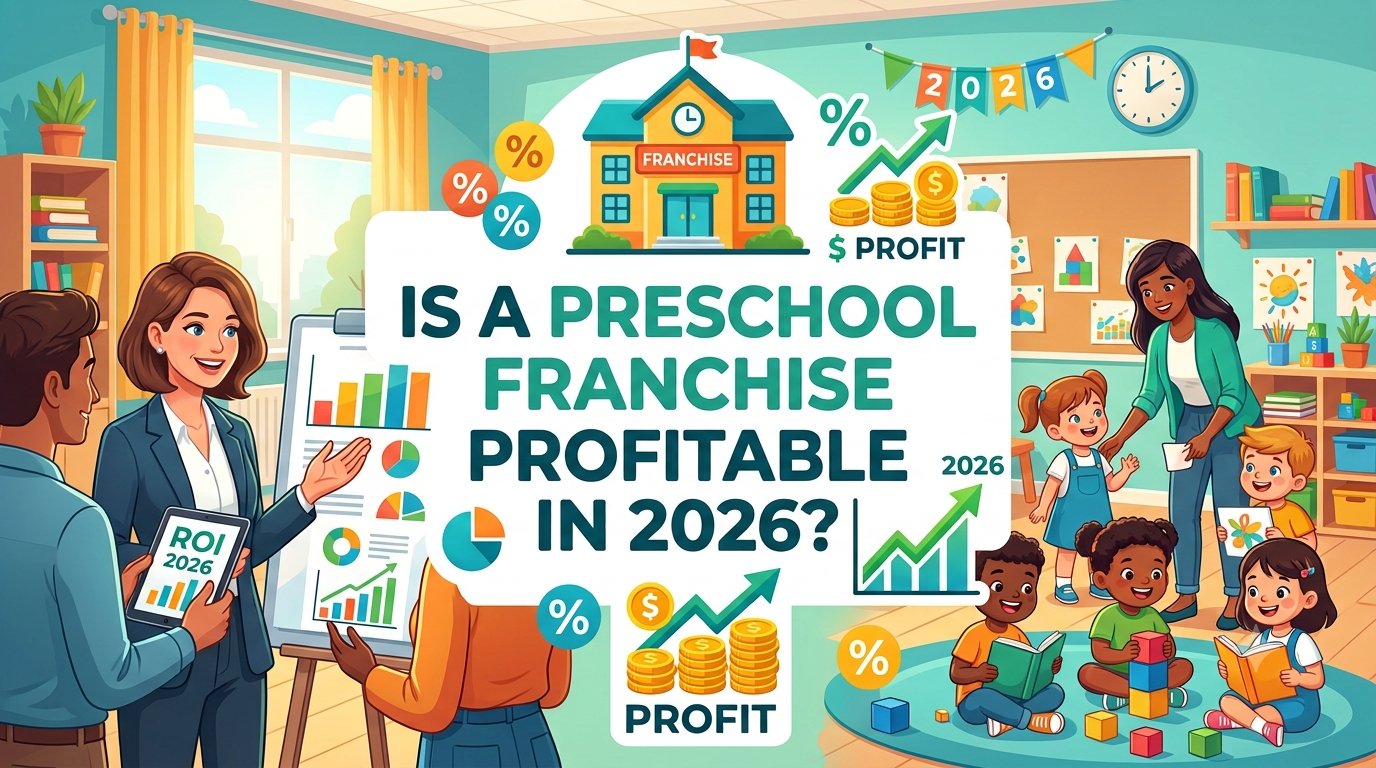
1. Introduction: Is a Preschool Franchise Profitable in 2026?
The demand for quality early childhood education continues to create interest in preschool businesses across India. As more parents recognize the importance of a strong foundation during the early years, entrepreneurs are exploring opportunities in the preschool and daycare sector. This has also increased interest in preschool franchises as a structured way to enter the education business.
So, is a preschool franchise profitable in 2026? Yes, a preschool franchise can be profitable in 2026, but profitability is not automatic. The financial performance of a preschool depends on how effectively the business manages its location, enrollment, pricing, expenses, and overall operations.
Unlike starting an independent preschool from scratch, a franchise can provide an established business model along with support such as curriculum, branding, teacher training, marketing guidance, and operational systems. These resources can help entrepreneurs avoid some of the challenges involved in building a preschool brand and operating model independently.
However, prospective franchise owners should look beyond the franchise brand or initial investment when evaluating profitability. Several factors can directly influence the financial performance of a preschool, including:
- Location and local demand: A preschool needs to be situated where there is sufficient demand from families with young children.
- Initial investment: Setup costs, interiors, equipment, franchise fees, and working capital need to be planned realistically.
- Student enrollment: The number of enrolled children is a major factor influencing revenue.
- Fee structure: Fees should be competitive while also supporting the school’s operating requirements.
- Operating expenses: Rent, utilities, learning materials, maintenance, and other expenses can significantly affect profitability.
- Staff costs: Qualified teachers and support staff are essential for delivering quality education and require careful workforce planning.
- Marketing and admissions: Consistent local marketing and effective lead conversion can help build and maintain enrollment.
- Quality of education and parent satisfaction: A positive learning environment and strong parent experience can support retention, referrals, and the long-term reputation of the preschool.
Therefore, a preschool franchise can offer a promising business opportunity in 2026, but entrepreneurs should make decisions based on realistic financial projections and local market research rather than assuming guaranteed returns. Understanding both the revenue potential and the ongoing costs is essential before making an investment.
2. Why Consider a Preschool Franchise in 2026?
- Explain why preschool education continues to attract entrepreneurs.
- Discuss increasing awareness among parents about early childhood education.
- Explain the advantages of a structured franchise model compared with starting a preschool independently.
- Cover potential benefits such as:
- Established brand identity
- Ready-to-use curriculum
- Training and operational guidance
- Marketing support
- Admission-generation strategies
- Standardized processes
- Explain that entrepreneurs should evaluate their local market before investing.
3. How Does a Preschool Franchise Make Money?
Explain the primary revenue sources available to a preschool franchise.
Main Revenue Sources
- Preschool tuition fees
- Admission or registration fees
- Daycare services
- Extended-day programs
- Activity or enrichment programs
- Transportation services, where applicable
- Summer camps and special programs
- Explain how multiple revenue streams can potentially improve the overall business model.
- Emphasize that revenue varies significantly by location, capacity, fees, and enrollment.
4. What Does a Preschool Franchise Cost in India in 2026?
- Explain the major components of preschool franchise investment.
- Break down potential expenses such as:
- Franchise fee
- Rent or property costs
- Interior setup
- Furniture and classroom equipment
- Learning materials
- Safety and security systems
- Technology
- Staff recruitment
- Marketing and launch expenses
- Working capital
- Licenses and compliance-related costs
- Explain the difference between initial investment and ongoing operating expenses.
- Advise prospective franchisees to request a complete cost sheet from the franchisor.
5. How to Calculate Preschool Franchise Profitability
Provide a simple framework entrepreneurs can use.
Basic Formula
Revenue – Operating Expenses = Operating Profit
Explain the key variables:
- Number of enrolled students
- Average annual fee per student
- Daycare/other service revenue
- Rent
- Salaries
- Utilities
- Marketing
- Supplies and maintenance
- Franchise or royalty-related charges, if applicable
Example Calculation
Provide a hypothetical example showing:
- 100 students
- Average annual fee
- Monthly operating expenses
- Annual revenue
- Estimated operating profit
Important: Clearly label the example as illustrative rather than a guaranteed return.
More info: https://www.growinnsteps.com/how-much-does-it-cost-to-start-a-playschool-franchise-in-india-2026/
6. What Factors Determine Preschool Franchise Profitability in 2026?
1. Location
- Residential density
- Number of families with young children
- Competition
- Accessibility
- Visibility
- Local income levels
2. Enrollment
- Enrollment is one of the biggest drivers of revenue.
- Explain why capacity utilization matters.
3. Fee Structure
- Fees should reflect the local market.
- Avoid setting prices solely based on competitors.
4. Operating Costs
- Rent and staff salaries can significantly affect margins.
- Effective cost management is important.
5. Brand Reputation
- Parents often consider trust, safety, teaching quality, and reputation when choosing a preschool.
6. Marketing and Admissions
- Explain the importance of digital marketing, local SEO, referrals, events, and parent engagement.
7. Quality of Education
- Strong teaching practices and a positive learning environment can support parent satisfaction and retention.
7. Preschool Franchise vs. Independent Preschool: Which Can Be More Profitable?
Create a comparison between the two models.
| Factor |
Preschool Franchise |
Independent Preschool |
| Brand recognition |
Established brand |
Built from scratch |
| Curriculum |
Usually provided |
Developed independently |
| Training |
Franchise support may be available |
Owner arranges training |
| Marketing |
Possible centralized/local support |
Owner-managed |
| Setup guidance |
Often available |
Self-managed |
| Initial franchise fee |
Usually applicable |
Not applicable |
| Flexibility |
May have brand guidelines |
Greater flexibility |
| Business support |
Structured support |
Depends on owner |
- Explain that neither model automatically guarantees higher profitability.
- The right choice depends on the entrepreneur’s experience, budget, location, and business goals.
8. How Long Does It Take for a Preschool Franchise to Become Profitable?
- Explain the difference between:
- Reaching break-even
- Recovering the initial investment
- Generating consistent profit
- Explain why a new preschool may take time to build enrollment.
- Discuss factors affecting the timeline:
- Initial enrollment
- Student retention
- Local competition
- Rent
- Marketing effectiveness
- Operating costs
- Avoid promising a fixed payback period unless supported by documented franchise data.
More info: https://www.growinnsteps.com/owning-a-preschool-franchise/
9. Is a pre-school franchise a good business for first-time entrepreneurs?
- Explain all points why franchising can be attractive to first-time business owners.
- Discuss the value of:
- Training
- Standard operating procedures
- Curriculum
- Marketing guidance
- Ongoing support
- Mention that franchise ownership still requires active management.
10. How to Choose a Profitable Preschool Franchise in-2026
Provide a practical checklist.
Entrepreneurs should evaluate:
- Total investment
- Franchise fee
- Royalty and recurring fees
- Minimum space requirements
- Location requirements
- Curriculum quality
- Teacher training
- Marketing support
- Admission support
- Technology and management systems
- Brand reputation
- Existing franchise network
- Renewal terms
- Exit or transfer conditions
- Financial disclosures and assumptions
Tip: Never choose a franchise based only on the lowest investment or highest claimed returns.
11. Preschool Franchise With Daycare can Be More Profitable?
- Explain the preschool + daycare model.
- Discuss how daycare can provide additional revenue beyond regular preschool hours.
- Explain factors to consider:
- Local working-parent demand
- Extended operating hours
- Additional staffing
- Infrastructure
- Food and care requirements
- Safety and supervision
- Clarify that additional revenue also means additional operating costs.
12. Common Mistakes That Can Reduce Preschool Franchise Profitability
Cover mistakes such as:
- Choosing a location without sufficient market research.
- Underestimating working capital.
- Overestimating student enrollment.
- Spending too much on interiors.
- Ignoring local competition.
- Hiring without considering staffing costs.
- Weak marketing and lead follow-up.
- Focusing on admissions while neglecting parent satisfaction.
- Not understanding franchise and recurring fees.
- Assuming projected ROI is guaranteed.
13. Why Grow Inn Steps Can Be Considered by Entrepreneurs Looking for a Preschool Franchise
Introduce Grow Inn Steps as an example for readers researching preschool franchise opportunities.
Cover relevant areas such as:
- Preschool and daycare business model
- Franchise setup support
- Curriculum and learning resources
- Teacher training
- Branding and marketing assistance
- Admission-generation support
- Technology and operational systems
- Ongoing franchise guidance
- Encourage potential franchisees to independently evaluate the investment, terms, support structure, and local market suitability before making a decision.
- Avoid unsupported claims about guaranteed revenue, profit, or ROI.
14. Questions to Ask Before Investing in a Preschool Franchise
Include a practical FAQ-style checklist:
- What is the total investment required?
- What does the franchise fee include?
- Are there royalty or recurring technology fees?
- What are the minimum space requirements?
- Does the franchisor assist with location selection?
- What training is provided?
- What marketing support is included?
- Is admission support provided?
- What curriculum and learning resources are included?
- What ongoing operational support is available?
- What are the renewal terms?
- Can I speak with existing franchisees?
15. FAQs: Preschool Franchise Profitability in 2026
Is a preschool franchise profitable in 2026?
- Explain that it can be profitable when demand, enrollment, pricing, and costs are managed effectively.
How much investment is required for a preschool franchise?
- Explain that investment varies by brand, city, property, size, and setup requirements.
How much can a preschool franchise earn?
- Explain that earnings depend on enrollment, fees, daycare revenue, operating costs, and location.
Is a preschool franchise better than starting independently?
- Compare the support and structure of franchising with the flexibility of an independent preschool.
Is daycare necessary for preschool franchise profitability?
- Explain that daycare can create an additional revenue stream but also increases operating requirements.
What is the biggest factor affecting preschool profitability?
- Highlight enrollment and cost management, while noting that location and local demand strongly influence both.
Is a preschool franchise suitable for first-time entrepreneurs?
- Explain the benefits of structured support while emphasizing the need for active business management.
16. Conclusion: Is a Preschool Franchise Profitable in 2026?
A preschool franchise can be profitable in 2026, but profitability is not automatic or guaranteed. Success depends on making informed decisions at every stage, from selecting the right location and planning a realistic investment to building strong enrollment and managing operating costs effectively.
The most important factors to consider include:
- The right location: Choose an area with sufficient demand from families with young children and assess local competition carefully.
- Realistic investment: Plan for both the initial setup and enough working capital to support the business as enrollment grows.
- A strong enrollment strategy: Consistent admissions are essential for generating sustainable revenue.
- Controlled operating costs: Manage rent, salaries, utilities, supplies, marketing, and other recurring expenses carefully.
- Quality education: A safe, engaging, and well-managed learning environment can help build trust with families.
- Parent satisfaction: Positive parent experiences can encourage retention, referrals, and a strong local reputation.
- Effective marketing: Local visibility, digital marketing, community outreach, and timely follow-up can support admissions.
- Reliable franchise support: Curriculum, training, branding, marketing, and operational guidance can be valuable when evaluating a franchise model.
Before investing, entrepreneurs should prepare a detailed financial projection based on their specific city, target market, expected enrollment, fee structure, and operating costs. Comparing these numbers with the franchise’s terms and support can help determine whether the opportunity fits their business goals.
If you are considering entering the early education sector, explore suitable preschool franchise opportunities, review the complete investment and support structure, and speak directly with the franchisor before making a final investment decision.
“Thinking about starting a preschool in 2026? Explore the Grow Inn Steps preschool franchise model and understand the investment, support, and requirements before taking the next step.”
