

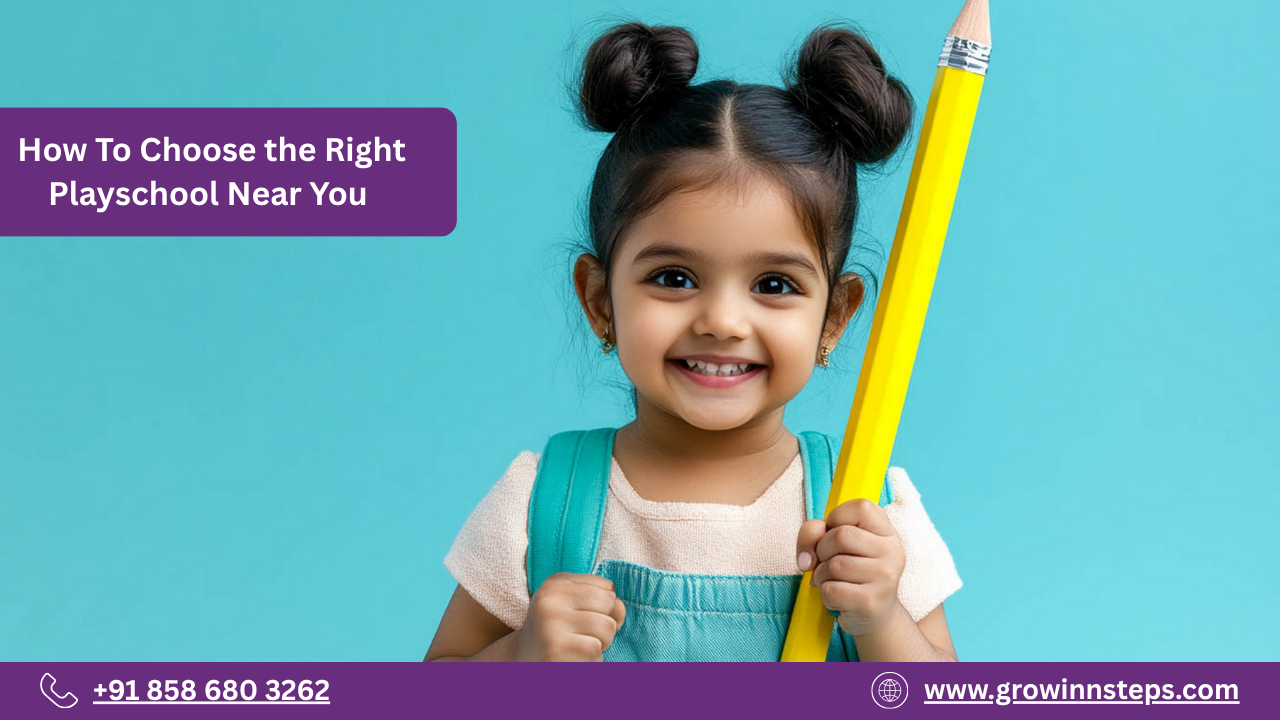
The moment your child hits the toddler years, a whirlwind of emotions takes over. Excitement, pride, and perhaps a little bit of anxiety swirl together as you realize your little one is ready to step out into the world. You begin the search for that perfect environment—a place that isn’t just a daycare, but a springboard for their development.
If you have spent your evenings typing “playschool near you” into search bars, you aren’t alone. Finding the right foundation for your child’s education is one of the most critical decisions you will make as a parent. But with so many options available, how do you sift through the noise to find the place that truly cares for your child’s growth?
At Growinnsteps, we believe that choosing a playschool is about finding a partnership for your child’s future. In this comprehensive guide, we will walk you through everything you need to consider to make an informed, confident decision.
Why the “First School” Matters More Than You Think
Many parents view playschool as a place to keep a child occupied while they work or manage household chores. While convenience is important, modern research shows that the foundations built between the ages of two and six are the most critical for brain development.
A high-quality playschool does more than teach colors and shapes. It fosters:
- Social-Emotional Development: Learning to share, empathize, and communicate.
- Cognitive Growth: Developing curiosity and problem-solving skills.
- Physical Coordination: Building fine and gross motor skills through play.
- Confidence: Providing a safe space to fail, try again, and succeed.
When you look for a playschool near you, you aren’t just looking for a building; you are looking for a community that aligns with your family’s values.
Phase 1: Creating Your Checklist
Before you start scheduling visits, pause and define your priorities. Every family is different. Use these categories to create your personal “must-have” list.
- The Educational Philosophy
Does the school follow a specific curriculum, such as Montessori, Reggio Emilia, or Play-Way?
- Montessori: Encourages independence and self-directed activity with specialized materials.
- Play-Way/Play-Based: Focuses on learning through natural interactions, games, and sensory experiences.
- Reggio Emilia: Highly child-led, focusing on projects and the environment as the “third teacher.”
- Proximity and Logistics
While “playschool near you” is the search term, define what “near” means. Is it near your office or your home? Consider the commute. A 45-minute bus ride for a three-year-old can be grueling. Ideally, the school should be within a 15-20 minute radius to ensure your child remains fresh and happy.
- Safety and Hygiene
This is non-negotiable. Look for:
- Secure entry/exit points (CCTV, guard presence).
- Child-proofed furniture (rounded edges, non-toxic materials).
- Clean washrooms and hygienic food preparation areas.
- A well-stocked first-aid kit and a clear protocol for emergencies.
Phase 2: The “Hidden” Signs of Excellence
When you walk into a classroom, try to look past the colorful decorations on the walls. Here is what you should really be looking for:
The “Squeal of Joy” Factor
Listen to the environment. Are the children engaged? Do they seem happy, even if they are busy? A good playschool is often buzzing with active play, laughter, and constructive chatter. If the classroom is perfectly silent, that may be a red flag for an overly rigid environment.
Teacher-to-Student Ratio
In early childhood education, one-on-one attention is everything. A teacher cannot foster emotional intelligence in a child if they are overwhelmed by 20 other toddlers. Look for a ratio that allows teachers to know your child’s individual personality, likes, and dislikes.
The Quality of Interactions
Watch how the teachers speak to the children. Are they on their knees, at the child’s eye level? Do they listen patiently when a child speaks? A teacher who guides through encouragement rather than commands is a gold standard.
Phase 3: Questions to Ask the Admissions Team
Don’t be afraid to be the “demanding parent.” This is your child’s educational start. Here are some essential questions for your site visits:
- “How do you handle separation anxiety?” Every child cries, but how the staff handles the transition from parent to classroom says everything about their empathy.
- “What is the policy on conflict resolution?” Do they teach children how to use their words? How do they handle biting or pushing?
- “How much time is spent outdoors?” Physical, unstructured play is vital for toddlers. Ensure there is a dedicated, safe play area.
- “What is the teacher retention rate?” A high turnover rate is a sign of a toxic work environment and can be very disruptive for your child, who needs consistent, familiar faces.
- “How do you communicate with parents?” Do they use an app? Do they send daily updates? Transparent communication builds trust.
Phase 4: Avoiding Common Pitfalls
Even with the best intentions, parents often fall into common traps during the search process.
- The “Fancy Building” Trap: A school might have high-tech equipment and expensive-looking toys, but that doesn’t mean the teaching quality is high. Focus on the human element—the educators.
- The “Academic Pressure” Trap: While you want your child to learn, avoid schools that boast about “getting children ready for primary school entrance tests” at age three. If a school focuses on rote memorization at a young age, they are ignoring the developmental stages of the brain.
- Over-relying on Reputation: Just because a parent at the park recommended a school doesn’t mean it’s the right fit for your child. Your child has a unique temperament; ensure the school caters to their specific personality.
The Growinnsteps Approach: Why Values Matter
At Growinnsteps, we understand that you aren’t just looking for a service—you are looking for a transition point between the warmth of home and the excitement of school.
We emphasize a balanced approach. We know that children learn best when they feel safe enough to explore. Our methodologies are designed to build confidence, curiosity, and character. When you search for a playschool near you, we want you to look for a place where your child isn’t just a face in the crowd, but a budding personality being nurtured.
Making the Final Decision: Trust Your Gut
After visiting three or four schools, you will likely have a “frontrunner.” Sometimes, you can’t quite put your finger on it, but you just feel it.
Ask yourself these final questions:
- Did my child feel comfortable walking into that room?
- Did the teachers seem genuinely interested in my child’s history and habits?
- Do the school’s values align with how we raise our child at home?
If the answer to these is yes, you have likely found the right place.
A Final Thought for Parents
Choosing the right playschool is the first time you “let go” a little bit. It is a milestone for both you and your child. Remember, there is no “perfect” school—there is only the right school for your family. By focusing on quality, safety, and a nurturing philosophy, you are ensuring the best possible start for your child.
Take a deep breath, trust your research, and get ready to watch your child blossom. They are about to embark on an incredible journey of discovery, and by choosing wisely, you are providing the best road map for that journey.
Are you ready to start your journey? Reach out to us at Growinnsteps to learn more about how we foster early growth and development in every child who walks through our doors. We’re here to help you every step of the way.
