

What Is Preschool Business Investment?
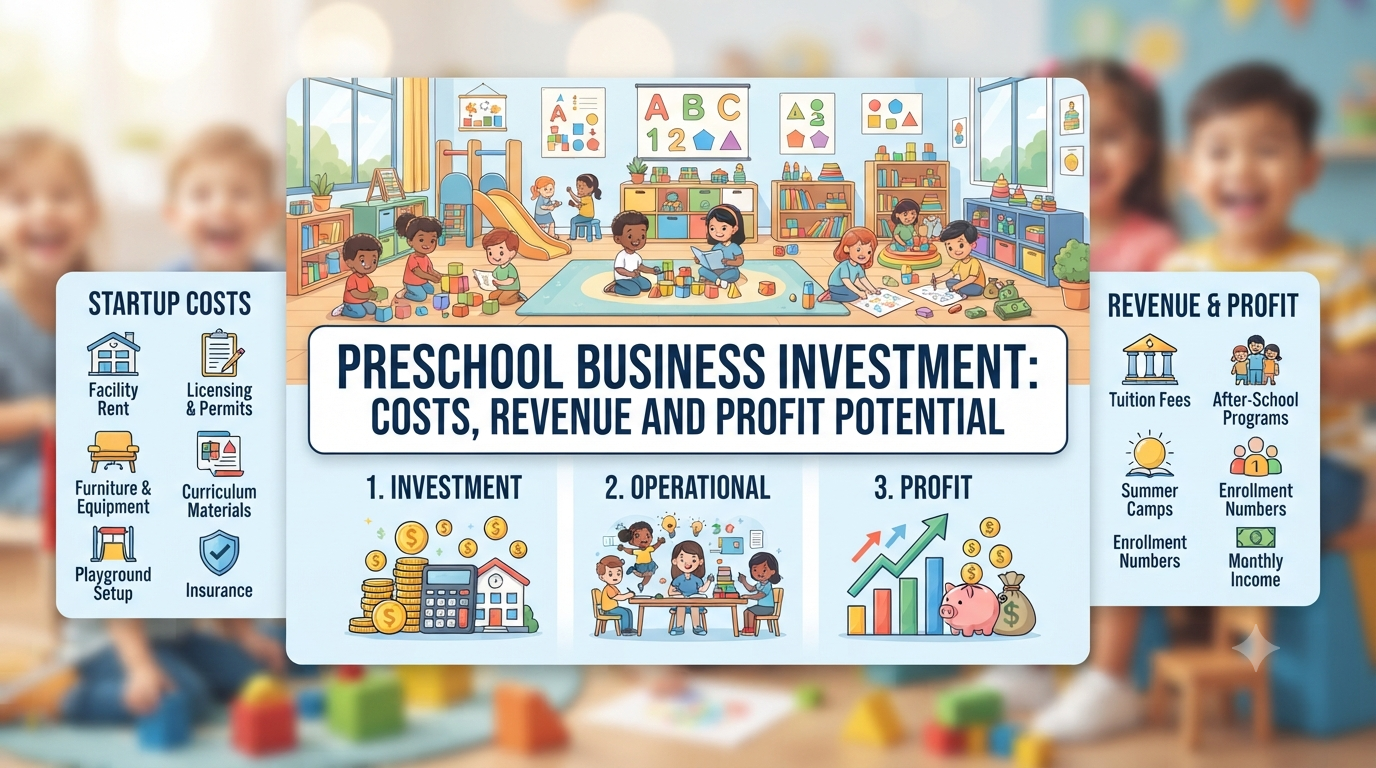
Preschool Business Investment: Costs, Revenue and Profit Potential: Grow Inn Steps refers to the capital required to establish and operate a preschool, along with the revenue and profitability potential generated from admissions, daycare, activities, and related services.
The investment typically includes:
- Property lease or deposit
- Interior development
- Furniture and classroom equipment
- Learning materials
- Safety and security systems
- Branding and signage
- Technology
- Staff recruitment and training
- Marketing and admissions
- Licenses and compliance
- Initial working capital
The exact investment varies significantly by city, property size, location, rent, infrastructure requirements, and business model.
Preschool Business Investment: Major Cost Components
A serious investor should divide the investment into one-time setup costs and recurring operating costs.
This distinction makes it easier to calculate the capital required before the preschool reaches stable enrollment.
- Property and Lease Costs
Property is often one of the biggest expenses.
A preschool generally needs a location that is convenient for families, visible, accessible, safe, and suitable for young children.
Before signing a lease, evaluate:
- Residential population
- Number of young families
- Competition
- Parking and accessibility
- Ground-floor accessibility
- Nearby apartments and residential communities
- Local purchasing power
- Visibility from the road
- Potential for future enrollment
Do not select a property based solely on low rent.
A cheaper property in a weak catchment area can generate significantly fewer admissions than a strategically located property with higher rent.
- Interior and Infrastructure
A preschool requires an environment designed specifically for young children.
Typical requirements include:
- Classrooms
- Activity areas
- Reception
- Child-friendly furniture
- Storage
- Washrooms
- Safety equipment
- Indoor play areas
- Learning displays
- Outdoor play facilities where possible
- CCTV and security infrastructure
The objective should be functional, safe, attractive infrastructure, rather than unnecessarily expensive decoration.
- Furniture and Learning Resources
Investment may include:
- Tables and chairs
- Shelving
- Montessori materials
- Books
- Puzzles
- Art supplies
- STEM activity materials
- Pretend-play resources
- Sensory learning equipment
- Sports and play equipment
A strong curriculum requires resources that support different stages of early childhood development.
- Branding and Marketing
Marketing should not be treated as an expense that ends after launch.
A new preschool needs consistent visibility before and after opening.
Potential marketing channels include:
- Google Business Profile
- Google Search Ads
- Meta Ads
- Local SEO
- Website
- Social media
- Parent referral programs
- Residential community outreach
- Events
- Open houses
- Local partnerships
- Outdoor branding
The objective is to create a predictable pipeline of parent inquiries and convert those inquiries into visits and admissions.
- Staff and Training
Staff expenses can become one of the largest recurring costs.
Depending on the center’s size, the team may include:
- Preschool teachers
- Assistant teachers
- Center head
- Caregivers
- Daycare staff
- Administrative personnel
- Housekeeping/security support
Training is equally important because teacher quality directly affects parent satisfaction, referrals, retention, and the reputation of the center.
Typical Preschool Investment Structure in India
There is no single investment figure applicable to every preschool.
For planning purposes, investors can use a broad framework:
|
Investment Area |
Typical Planning Category |
| Property deposit/advance |
Location dependent |
|
Interiors |
One-time setup |
| Furniture |
One-time setup |
|
Learning resources |
One-time + recurring |
| Branding |
One-time |
|
Technology & CCTV |
One-time |
| Licenses/compliance |
Location dependent |
|
Recruitment/training |
Pre-launch |
| Launch marketing |
Pre-launch |
|
Working capital |
3–6+ months recommended |
For a branded preschool franchise, the total investment may also include the franchise fee, setup support, curriculum, training, branding, and other franchise-related costs.
For example, Grow Inn Steps has positioned its franchise opportunity around an investment range of approximately ₹35–45 lakh, depending on location and project requirements. Investors should confirm the current commercial terms, inclusions, and location-specific costs directly before making a financial decision.
How Does a Preschool Generate Revenue?
The strongest preschool businesses do not depend on one revenue source.
- Preschool Admissions
The primary revenue stream is tuition and admission-related fees.
Revenue depends on:
Number of enrolled children × Average annual revenue per child
For example, if a center reaches 100 students and generates an average annual revenue of ₹60,000 per child:
100 × ₹60,000 = ₹60 lakh annual gross revenue
This is an illustrative calculation—not a guaranteed result.
- Daycare Revenue
Daycare can significantly increase revenue per customer because parents may require longer-hour childcare in addition to preschool education.
Possible daycare revenue models include:
- Monthly plans
- Full-day plans
- Extended-hour packages
- Annual daycare packages
- Activity and Enrichment Programs
Additional programs can create incremental revenue while improving the center’s value proposition.
Examples include:
- Art and craft
- Dance
- Music
- Sports
- STEM activities
- Summer camps
- Holiday programs
- Special workshops
These should complement the core preschool offering rather than distract from it.
- Extended Care
Working parents may value extended operating hours.
A carefully structured extended-care program can improve customer retention and increase revenue per family.
Preschool Profit Potential: What Determines Profitability?
Revenue alone does not determine profitability.
The important metric is contribution after operating expenses.
A simplified formula is:
Profit = Total Revenue − Operating Expenses
Major operating expenses include:
- Rent
- Salaries
- Utilities
- Marketing
- Maintenance
- Consumables
- Software
- Security
- Housekeeping
- Administrative expenses
Example Profitability Scenario
Consider an illustrative center generating:
100 students × ₹60,000 average annual revenue = ₹60 lakh revenue
Suppose total annual operating expenses are approximately ₹45 lakh.
The simplified operating surplus would be:
₹60 lakh − ₹45 lakh = ₹15 lakh
This is only an example. Actual results can be substantially different depending on rent, salaries, pricing, enrollment, daycare revenue, marketing costs, and local market conditions.
The Most Important Metric: Break-Even Enrollment
Investors should calculate the number of students required to cover monthly expenses.
For example:
Monthly fixed and semi-variable expenses = ₹4 lakh
Average monthly contribution per enrolled child = ₹5,000
Break-even enrollment:
₹4,00,000 ÷ ₹5,000 = 80 students
This means the center would need approximately 80 active enrollments under these assumptions to reach operating break-even.
This calculation is much more useful than looking at headline revenue numbers alone.
How to Improve Preschool Profit Margins
Optimize Property Costs
Rent should remain proportional to realistic enrollment potential.
A premium property can make sense if it generates substantially stronger admissions, but investors should model the numbers before committing.
Increase Revenue Per Family
Daycare and extended-care services can increase the lifetime value of a parent customer.
However, these services require additional staffing and operational capacity, so they should be priced carefully.
Focus on Retention
Acquiring a new parent can cost more than retaining an existing family.
Strong teacher-parent communication, child safety, learning outcomes, and consistent experiences can improve retention and referrals.
Build Local SEO
Parents frequently search for terms such as:
- Preschool near me
- Play school near me
- Daycare near me
- Best preschool in [location]
- Preschool and daycare in [location]
A well-optimized Google Business Profile, website, reviews, local content, and location pages can create an important long-term acquisition channel.
Track Marketing ROI
Don’t measure marketing simply by leads.
Track:
Ad spend → Leads → Calls → Visits → Admissions → Revenue
For example, 100 low-quality leads may be less valuable than 30 highly relevant parent inquiries.
Why Location Matters More Than Many Investors Expect
Preschool is fundamentally a local business.
Parents usually prefer centers that are close to home or work.
Therefore, investors should analyze the catchment area before investing.
Evaluate:
- Number of residential units nearby
- Families with young children
- Existing preschool competition
- Average fee levels
- Household purchasing power
- Road accessibility
- Parking
- Local reputation
- Daycare demand
- Future residential development
A location with a strong concentration of young families can provide a better admission pipeline than a high-visibility commercial location with limited residential demand.
Independent Preschool vs Preschool Franchise
Investors typically have two options.
Independent Preschool
You control:
- Brand
- Curriculum
- Pricing
- Marketing
- Operations
- Hiring
- Positioning
However, you must build the entire system yourself.
That means developing the brand, curriculum, processes, marketing strategy, training systems, and admissions engine from scratch.
Preschool Franchise
A franchise may provide:
- Established brand identity
- Curriculum framework
- Training
- Center setup guidance
- Marketing support
- Operational systems
- Admission support
- Business guidance
The trade-off is that franchisees operate within defined brand standards and may pay franchise-related fees or royalties.
For an investor who values a structured launch process, the franchise model can reduce the amount of system-building required.
Preschool Business Investment: How Grow Inn Steps Can Support Investors
The Preschool Business Investment opportunity should be evaluated as a complete business model rather than simply as an interior setup or franchise purchase.
Grow Inn Steps can be considered by investors looking for a structured preschool franchise approach that combines branding, curriculum, training, marketing, and operational support.
Key areas investors should examine include:
Complete Setup Support
A structured setup process can help investors move from property selection to center launch with fewer operational uncertainties.
Curriculum and Training
Teacher training and curriculum systems can help maintain consistency across classrooms and centers.
Marketing Assistance
A preschool requires continuous admissions marketing.
Support across digital marketing, branding, local visibility, and admissions campaigns can help franchise partners build their local presence.
Business Model
Investors should examine the complete commercial model, including:
- Initial investment
- Franchise fees
- Royalty structure
- Setup costs
- Working capital
- Expected enrollment
- Pricing
- Operating expenses
- Break-even point
- Potential ROI
Never evaluate a franchise opportunity based on projected revenue alone.
How Much Working Capital Should You Keep?
One of the most common mistakes investors make is spending almost all available capital on setup.
The center may look impressive on opening day but struggle to fund operations while enrollment grows.
A better approach is to maintain a working-capital reserve for:
- Salaries
- Rent
- Marketing
- Utilities
- Maintenance
- Consumables
- Unexpected expenses
A practical business plan should model at least several months of operating expenses before assuming the center will immediately reach stable enrollment.
A 5-Step Preschool Investment Strategy
Step 1: Validate the Location
Study demographics, competition, fees, residential density, and parent demand.
Step 2: Build a Complete Investment Model
Include setup costs plus working capital.
Step 3: Calculate Break-Even Enrollment
Determine exactly how many students are required to cover operating expenses.
Step 4: Build the Admission Engine
Create a combination of:
- Google Search
- Local SEO
- Google Business Profile
- Meta advertising
- Events
- Open houses
- Parent referrals
- Community marketing
Step 5: Track Unit Economics
Monitor:
Cost per lead → Cost per visit → Cost per admission → Revenue per child → Retention → Profit
This gives investors a much clearer view of business health.
Is a Preschool a Good Investment?
A preschool can be an attractive business opportunity when the location, investment structure, enrollment strategy, pricing, and operating model are aligned.
The strongest opportunities usually come from areas with growing young-family populations, strong demand for early childhood education, manageable competition, and sufficient purchasing power.
However, no preschool franchise or independent preschool can guarantee admissions, revenue, or profit. Investors should conduct local market research and review the complete financial model before committing capital.
Final Thoughts
A preschool should be approached as both an education business and a local service business.
The investment creates the infrastructure, but enrollment creates revenue. Strong operations convert revenue into profit, while parent satisfaction and local reputation create sustainable growth.
For investors evaluating Preschool Business Investment: Costs, Revenue and Profit Potential, the most important questions are:
- What is the total investment?
- What does the investment include?
- How much working capital is required?
- What enrollment is needed to break even?
- What are realistic fee levels in the target location?
- What are the expected monthly operating expenses?
- What support does the franchise provide?
- How will admissions be generated?
- What are the franchise fees and royalty obligations?
- What assumptions support the projected ROI?
A disciplined financial model, strong location strategy, and reliable admissions system are ultimately more important than an attractive preschool interior.
Frequently Asked Questions
- How much investment is required to start a preschool in India?
The investment varies by city, property, size, interiors, staffing, and business model. A branded preschool franchise may require approximately ₹35–45 lakh or more, depending on project specifications and location.
- How does a preschool make money?
A preschool primarily earns through admission and tuition fees. Additional revenue can come from daycare, extended care, enrichment programs, camps, and other child-focused services.
- How profitable is a preschool business?
Profitability depends on enrollment, average revenue per child, rent, salaries, marketing expenses, and other operating costs. Investors should calculate break-even enrollment before estimating profit.
- Is a preschool franchise better than starting independently?
A franchise can provide established branding, curriculum, training, setup assistance, and marketing or operational support. An independent preschool offers greater control but requires the owner to develop these systems independently.
- What is the most important factor in preschool investment?
Location and enrollment potential are among the most important factors. A strong catchment area with sufficient families, purchasing power, and manageable competition can significantly influence the business’s revenue potential.
