

-
Introduction: Why STEM Matters in the Preschool Years
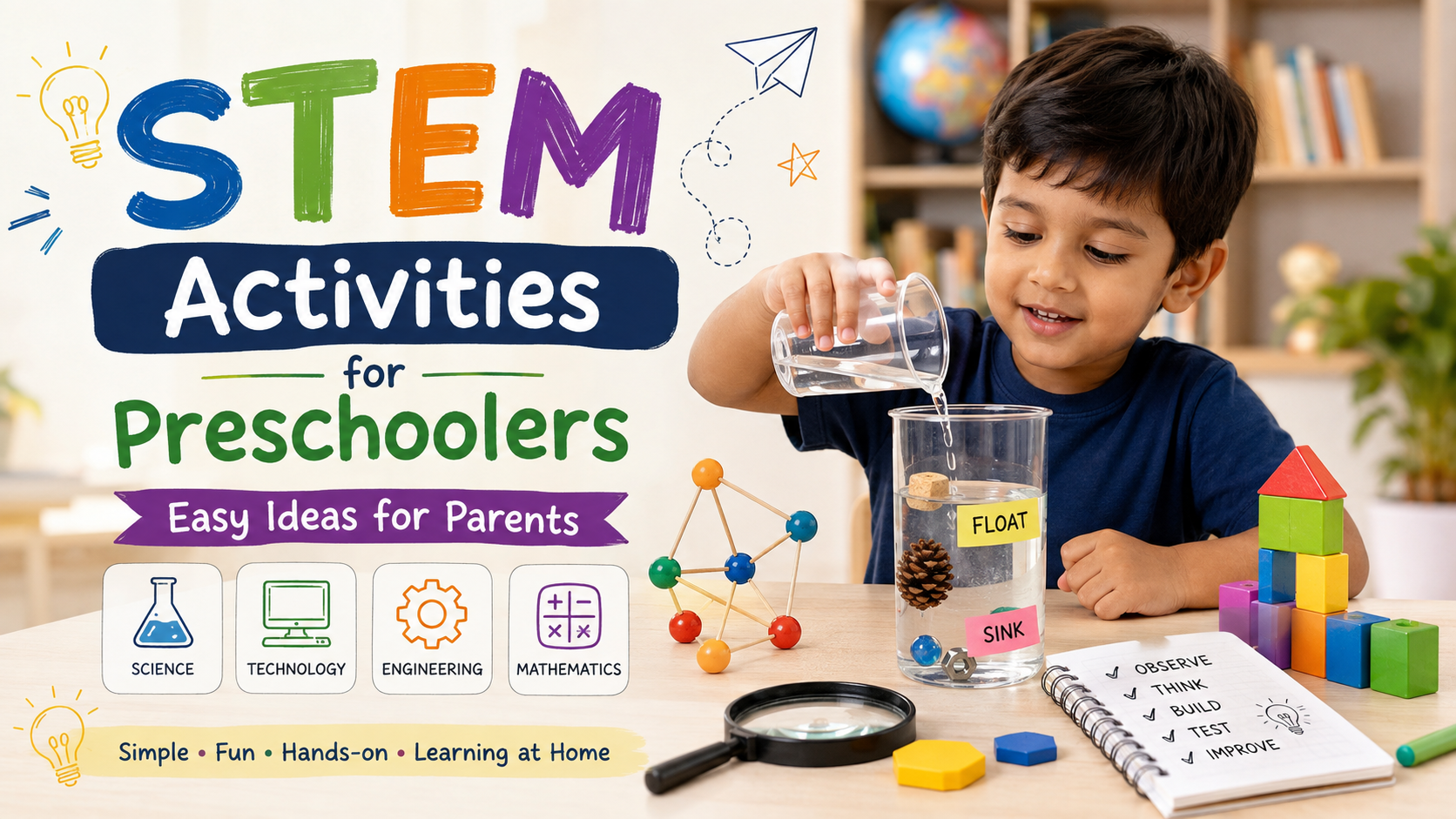
STEM—Science, Technology, Engineering, and Mathematics—is not just for older children. Preschool is an excellent time to introduce STEM concepts because young children are naturally curious, love to explore, and learn best through hands-on experiences.
Everyday play can become a STEM learning opportunity. When a child asks why an object floats, builds a tower with blocks, counts toys, observes a plant growing, or tries to figure out why a toy car rolls faster down one ramp than another, they are already practicing early STEM skills. These activities help children develop curiosity, observation, creativity, logical thinking, and problem-solving abilities.
The good news for parents is that STEM activities do not require expensive educational toys, complicated experiments, or a special classroom. Simple materials such as paper, cardboard, blocks, water, cups, household objects, and items from nature can provide plenty of opportunities for exploration.
In this guide, you’ll discover easy STEM activities for preschoolers that parents can try at home. These simple, safe, and fun activities encourage children to ask questions, make predictions, test ideas, and learn from what they observe—all while turning everyday play into meaningful learning.
Top of Form
-
What Is STEM Education for Preschoolers?
STEM education for preschoolers is a fun, hands-on way of helping young children understand the world around them. STEM stands for Science, Technology, Engineering, and Mathematics. At the preschool level, it does not mean formal lessons or complicated experiments. Instead, it encourages children to explore, ask questions, build things, count, observe, test ideas, and find solutions through everyday play.
Here is what each part of STEM can look like for a preschooler:
- Science: Children learn by observing and exploring the world around them. Watching a seed grow, discovering which objects sink or float, or observing changes in weather are simple examples of early science learning.
- Technology: Technology is not limited to computers and tablets. Children can explore how everyday tools and objects work, such as flashlights, magnifying glasses, wheels, or simple machines.
- Engineering: Engineering encourages children to design, build, test, and improve things. Building a tower with blocks or creating a bridge for toy cars helps children practice early engineering skills.
- Mathematics: Preschoolers develop early math skills through counting, sorting, comparing sizes, measuring objects, identifying shapes, and recognizing patterns.
The real value of preschool STEM activities is that they encourage children to think rather than simply memorize information. When children make a prediction, test an idea, discover that something does not work, and try again, they are developing curiosity, creativity, critical thinking, and problem-solving skills.
For parents, STEM learning can be as simple as asking, “What do you think will happen?” or “How can we make this stronger?” These small questions turn everyday play into meaningful learning and help children become confident, curious learners.
-
Benefits of STEM Activities for Preschoolers
- Develops problem-solving skills.
- Encourages curiosity and questioning.
- Builds early math and science skills.
- Strengthens fine motor skills.
- Encourages creativity and imagination.
- Improves concentration and observation.
- Builds confidence through experimentation.
- Encourages teamwork and communication when children work with parents or siblings.
-
15 Easy STEM Activities for Preschoolers at Home
Activity 1: Build a Tower With Blocks
- Materials: Building blocks, LEGO-style blocks, or recycled boxes.
- What to do: Ask children to build the tallest stable tower.
- STEM skills: Engineering, balance, problem-solving, measurement.
- Parent prompt: “What can you change to make your tower stronger?”
Activity 2: Sink or Float Experiment
- Materials: Bowl of water and safe household objects.
- What to do: Let children predict whether each item will sink or float, then test it.
- STEM skills: Science, prediction, observation, classification.
- Parent prompt: “Why do you think this one floats?”
Activity 3: Make a Simple Color-Mixing Experiment
- Materials: Water, transparent cups, and washable food coloring.
- What to do: Mix primary colors to discover new colors.
- STEM skills: Observation, experimentation, cause and effect.
- Safety note: Use child-safe materials and supervise closely.
Activity 4: Create a Paper Bridge
- Materials: Paper, books, and small toy cars or blocks.
- What to do: Challenge children to create a bridge that can hold a toy.
- STEM skills: Engineering, design, testing, problem-solving.
- Extension: Try folding or rolling the paper to make it stronger.
Activity 5: Nature Sorting Challenge
- Materials: Leaves, stones, sticks, flowers, or other safe natural objects.
- What to do: Ask children to sort objects by size, shape, color, or texture.
- STEM skills: Classification, observation, early mathematics.
Activity 6: DIY Measuring Fun
- Materials: Ruler, measuring tape, or non-standard measuring objects such as blocks.
- What to do: Measure toys, books, furniture, or other safe objects.
- STEM skills: Measurement, comparison, counting.
- Parent prompt: “Which object is longer? How many blocks long is it?”
Activity 7: Make a Homemade Ramp
- Materials: Cardboard, books, and toy cars.
- What to do: Create ramps with different heights and test how far the car travels.
- STEM skills: Physics, observation, comparison, cause and effect.
Activity 8: Build a Shape Puzzle
- Materials: Paper, cardboard, or craft sticks.
- What to do: Create simple shapes and challenge children to combine them into pictures or larger shapes.
- STEM skills: Geometry, spatial reasoning, creativity.
Activity 9: Ice Rescue Experiment
- Materials: Ice cubes, water, cups, and child-safe tools.
- What to do: Freeze small toys inside ice and let children explore safe ways to free them.
- STEM skills: Observation, problem-solving, understanding temperature and melting.
Activity 10: Pattern-Making Game
- Materials: Colored blocks, buttons, toys, or household objects.
- What to do: Create simple patterns such as red-blue-red-blue and ask children to continue them.
- STEM skills: Early mathematics, sequencing, logical thinking.
Activity 11: Build a Marble or Ball Run
- Materials: Cardboard tubes, paper, tape, and small balls.
- What to do: Build a pathway and test how the ball moves through it.
- STEM skills: Engineering, design, gravity, problem-solving.
- Safety note: Avoid small objects with children who may put them in their mouths.
Activity 12: Shadow Science
- Materials: Flashlight and everyday objects.
- What to do: Shine a flashlight from different angles and observe how shadows change.
- STEM skills: Observation, light and shadow, spatial awareness.
Activity 13: Count and Sort Everyday Objects
- Materials: Safe household items such as spoons, socks, large buttons, or toy animals.
- What to do: Count, group, compare, and arrange objects.
- STEM skills: Counting, sorting, addition concepts, classification.
Activity 14: Design a Paper Boat
- Materials: Paper and a container of water.
- What to do: Make a simple paper boat and see how many lightweight objects it can carry.
- STEM skills: Engineering, floating, testing, redesigning.
- Parent prompt: “How can we change the boat so it can carry more?”
Activity 15: Grow a Mini Plant
- Materials: Seeds, cotton or soil, a small container, and water.
- What to do: Plant a seed and observe its growth over several days or weeks.
- STEM skills: Biology, observation, measurement, responsibility.
- Extension: Keep a simple picture-based growth journal.
-
How Parents Can Make STEM Activities More Meaningful
- Let children make predictions before testing.
- Ask open-ended questions instead of immediately giving answers.
- Encourage children to try again when something does not work.
- Allow children to make mistakes and learn from them.
- Connect activities to everyday situations.
- Let children explain what they discovered in their own words.
- Focus on the learning process rather than getting the “right” answer.
-
STEM Questions Parents Can Ask During Activities
Include simple prompts such as:
- “What do you think will happen?”
- “Why do you think that happened?”
- “What could we change?”
- “Which one is bigger or smaller?”
- “How can we make it stronger?”
- “What happens if we try it another way?”
- “Can you find a pattern?”
- “What did you discover?”
-
Safety Tips for Preschool STEM Activities
- Always supervise young children during experiments.
- Avoid activities involving hot water, sharp objects, chemicals, or electrical equipment.
- Use age-appropriate materials.
- Be cautious with small objects that may be choking hazards.
- Use washable, child-safe materials whenever possible.
- Keep experiments simple and stop if a child becomes uncomfortable.
-
How STEM Activities Support Preschool Learning
- Connect home activities with classroom learning.
- Explain how STEM supports school readiness.
- Show how activities strengthen cognitive, language, social, and motor development.
- Highlight that STEM learning can happen naturally through play and exploration.
-
Frequently Asked Questions
Q. What are the best STEM activities for preschoolers?
Briefly recommend simple activities involving building, sorting, measuring, observing, experimenting, and problem-solving.
Q. How can I teach STEM to my preschooler at home?
Explain that parents can use everyday activities, questions, play, and household materials rather than formal lessons.
Q. What age can children start STEM activities?
Explain that children can begin age-appropriate STEM exploration during the preschool years and even earlier through supervised play.
Q. Do STEM activities require expensive materials?
Clarify that many effective STEM activities can be done with paper, blocks, water, cardboard, household objects, and natural materials.
Q. How do STEM activities help preschoolers?
Summarize benefits such as curiosity, problem-solving, early math and science understanding, creativity, and critical thinking.
-
Conclusion: Make STEM Part of Everyday Play
- Reinforce that STEM learning does not need to feel like a formal lesson; it can naturally happen through play, conversation, and everyday exploration.
- Encourage parents to turn children’s questions and playtime into opportunities to observe, experiment, build, count, and solve problems.
- Remind parents that curiosity is one of the most important foundations of early STEM learning.
- Encourage families to start with one simple activity and gradually introduce new challenges as children become more confident.
- End with a positive message about helping children become confident, curious, and creative learners who enjoy discovering how the world works.
