

Introduction
Choosing between daycare and preschool is one of the first major decisions parents make during their child’s early years. While both provide a safe, nurturing environment for young children, they are designed to meet different needs. Understanding the differences between daycare vs preschool can help you select the option that best supports your child’s development and fits your family’s lifestyle.
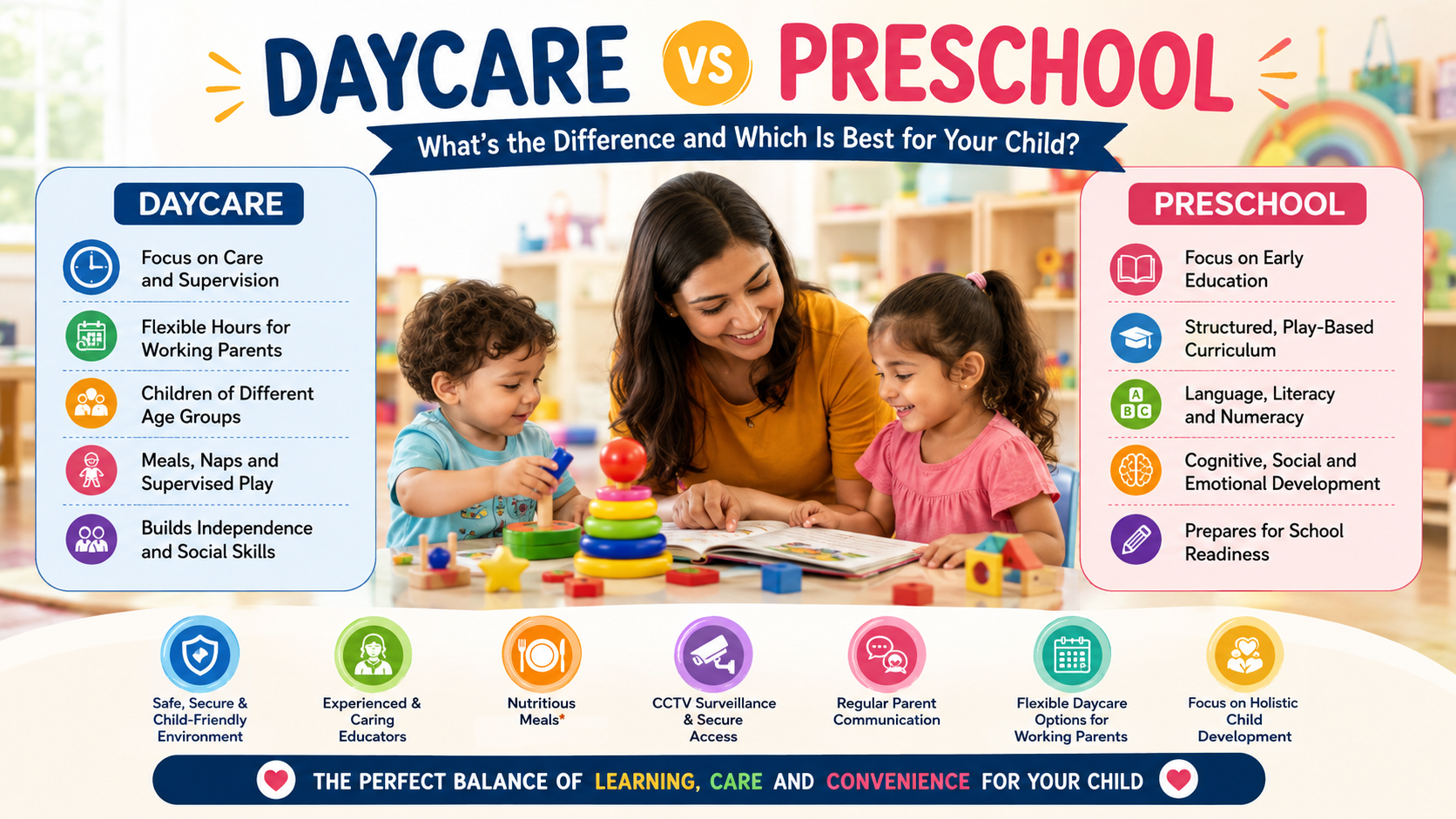
A daycare primarily focuses on providing reliable childcare for infants, toddlers, and preschoolers, making it an ideal choice for working parents who need flexible, full-day care. In contrast, a preschool emphasizes early childhood education through a structured, play-based curriculum that prepares children for kindergarten and formal schooling. Although some centers offer both services under one roof, their objectives, daily routines, learning approaches, and schedules can vary significantly.
In this comprehensive guide, we’ll compare daycare vs preschool across key factors such as age groups, curriculum, operating hours, costs, teacher qualifications, and developmental benefits. We’ll also discuss the advantages of each option, explain which is better suited for different family situations, and share practical tips to help you make an informed decision. By the end of this article, you’ll have a clear understanding of whether a daycare, a preschool, or a combination of both is the right choice for your child’s growth, learning, and overall well-being.
What Is a Daycare?
A daycare is a childcare facility that provides a safe, supervised, and nurturing environment for children while their parents or guardians are at work or managing other responsibilities. Unlike a preschool, which primarily focuses on early education, a daycare combines quality care with age-appropriate activities that support a child’s physical, social, emotional, and cognitive development throughout the day.
Purpose of a Daycare
The primary purpose of a daycare is to provide dependable childcare in a safe and stimulating environment. In addition to supervising children, daycare centers help establish healthy routines, encourage social interaction, foster independence, and support early developmental milestones. They also give parents peace of mind, knowing their child is receiving attentive care throughout the day.
Typical Age Groups
Most daycare centers welcome children across a wide range of ages, including:
- Infants (around 6 months and older)
- Toddlers (1–3 years)
- Preschool-age children (3–5 years)
- After-school care for older children (at some centers)
Children are usually grouped according to their age and developmental stage so that activities, routines, and supervision are appropriate for their needs.
Flexible Hours for Working Parents
One of the biggest advantages of daycare is its flexibility. Many centers operate for extended hours, often from early morning until evening, making them an ideal solution for working parents. Some daycare facilities also offer:
- Full-day and half-day programs
- Extended care before and after school
- Emergency or occasional childcare
- Holiday and vacation care
These flexible options help families balance work commitments while ensuring their children receive consistent care.
Daily Routine in a Daycare
Although schedules may vary by center, a typical daycare routine includes a balance of learning, play, and rest. Children usually participate in:
- Welcome and free-play time
- Circle time, storytelling, or music sessions
- Creative art and craft activities
- Indoor and outdoor play
- Learning through games and exploration
- Snack and meal breaks
- Nap or quiet time
- Group activities and social interaction
A predictable daily routine helps children feel secure, develop positive habits, and build confidence.
Meals, Naps, and Supervised Play
Quality daycare centers focus on children’s overall well-being by providing nutritious meals and snacks (where applicable), scheduled nap times, and plenty of supervised play. Outdoor games, sensory activities, building blocks, pretend play, and creative projects encourage physical development, imagination, and problem-solving skills while ensuring children remain active and engaged throughout the day.
Social Interaction Opportunities
Daycare gives children valuable opportunities to interact with peers in a supportive environment. Through group activities and collaborative play, they learn essential life skills such as sharing, communication, teamwork, empathy, patience, and conflict resolution. These early social experiences help children build confidence, develop friendships, and adapt more easily to preschool and formal schooling later on.
What Is a Preschool?
A preschool is an early childhood education center designed to prepare young children for formal schooling through structured, age-appropriate learning experiences. Unlike daycare, which primarily focuses on childcare and supervision, a preschool emphasizes educational development by nurturing a child’s cognitive, social, emotional, physical, and language skills in a fun and engaging environment.
Preschools create a strong foundation for lifelong learning by encouraging curiosity, creativity, independence, and confidence. Through a combination of guided activities, interactive lessons, and play-based experiences, children develop essential skills that help them transition smoothly into kindergarten or primary school.
Focus on Early Childhood Education
The primary goal of a preschool is to support early childhood education during the most important years of brain development. Children are introduced to foundational concepts in literacy, numeracy, communication, and problem-solving while developing positive learning habits. Rather than memorization, preschools encourage exploration, discovery, and hands-on experiences that make learning enjoyable and meaningful.
Structured Curriculum
Most preschools follow a well-planned curriculum that balances academics with creative and physical development. Depending on the school’s educational approach, the curriculum may include:
- Language and communication skills
- Early reading and phonics
- Basic mathematics and number recognition
- Science and environmental awareness
- Art, music, and creative expression
- Physical activities and motor skill development
- Storytelling and imaginative play
- Social and emotional learning
A structured curriculum ensures children progress through age-appropriate milestones while developing a love for learning.
Typical Age Groups
Preschools generally cater to children between 2 and 5 years of age, although admission age may vary slightly depending on the institution. Common preschool programs include:
- Playgroup: 2–3 years
- Nursery: 3–4 years
- Junior Kindergarten (LKG): 4–5 years
- Senior Kindergarten (UKG): 5–6 years
Each stage is designed to match the child’s developmental needs and gradually prepare them for formal education.
Play-Based Learning
One of the defining features of a preschool is its play-based learning approach. Children learn best through exploration and hands-on experiences rather than traditional classroom instruction. Activities such as puzzles, building blocks, role play, storytelling, music, art, sensory play, and outdoor games help children understand new concepts while making learning enjoyable.
Play-based learning also encourages creativity, critical thinking, collaboration, and problem-solving—skills that are essential for future academic success.
School Readiness
A preschool plays a vital role in preparing children for the transition to kindergarten or primary school. Children become familiar with classroom routines, following instructions, working independently, participating in group activities, and interacting respectfully with teachers and classmates.
Development of Cognitive, Language, and Social Skills
Preschool supports holistic development by helping children grow in multiple areas:
- Cognitive Development: Improves memory, attention, reasoning, problem-solving, and early mathematical thinking.
- Language Development: Expands vocabulary, strengthens listening and speaking abilities, and introduces early reading and writing skills.
- Social Development: Teaches children how to share, cooperate, communicate, build friendships, and work as part of a group.
- Emotional Development: Encourages self-confidence, emotional regulation, empathy, resilience, and independence.
- Physical Development: Enhances fine and gross motor skills through activities such as drawing, cutting, dancing, climbing, and outdoor play.
Overall, a preschool provides much more than academic preparation. It creates a nurturing environment where children develop the knowledge, confidence, and life skills needed to thrive in school and beyond, making it an essential step in a child’s early learning journey.
Daycare vs Preschool: Key Differences
Create a comparison table covering:
| Feature | Daycare | Preschool |
| Purpose | Childcare | Early education |
| Age Group | Infants to 5+ years | 2–5 years |
| Learning Focus | Play and care | Structured learning |
| Operating Hours | Full day | Half day/Fixed hours |
| Curriculum | Limited | Comprehensive |
| Teachers | Caregivers | Trained early childhood educators |
| Meals | Usually included | Depends on school |
| School Readiness | Moderate | High |
| Parent Communication | Daily updates | Progress reports & meetings |
| Best For | Working parents | Preparing children for formal school |
Benefits of Daycare
A quality daycare offers much more than childcare—it provides a safe, nurturing environment where children can learn, play, and develop essential life skills while giving parents peace of mind.
One of the biggest advantages of daycare is its convenience for working parents. Most daycare centers offer longer operating hours than preschools, making it easier to balance work and family responsibilities. Children are cared for by trained professionals in a secure setting with proper supervision, age-appropriate activities, and safety measures.
Daycare also encourages socialization by allowing children to interact with peers of different ages. Through group play and shared activities, they learn communication, teamwork, sharing, and empathy. Following a consistent daily routine of meals, naps, learning, and play helps children feel secure and develop healthy habits.
Another key benefit is that daycare promotes independence. Children gradually learn to complete simple tasks on their own, boosting their confidence and self-reliance. Many centers also offer flexible attendance options, including full-day, half-day, and part-time care to suit different family schedules.
Overall, daycare supports children’s physical, emotional, social, and cognitive development while providing reliable, flexible care that meets the needs of modern families.
Benefits of Preschool
A preschool provides children with a strong foundation for lifelong learning by combining education with play in a structured, nurturing environment. Through age-appropriate activities, children develop the academic, social, and emotional skills needed for future success.
One of the biggest benefits of preschool is its structured learning environment, where children follow a daily routine that builds discipline, confidence, and independence. Preschool also promotes language development by encouraging conversations, storytelling, singing, and vocabulary-building activities.
Children develop cognitive skills through puzzles, games, and hands-on learning experiences that strengthen memory, attention, and problem-solving abilities. Early exposure to literacy and numeracy helps them recognize letters, sounds, numbers, shapes, and patterns, preparing them for formal schooling.
Preschool also supports emotional growth by teaching children how to express their feelings, manage emotions, and build self-confidence. Through group activities and play, they develop important social skills such as sharing, cooperation, communication, and teamwork.
Creative activities like art, music, role play, and building exercises encourage creativity and critical thinking, helping children explore new ideas and solve problems independently. Most importantly, preschool prepares children for kindergarten by introducing classroom routines, following instructions, and fostering a love for learning, ensuring they are confident and ready for the next stage of their educational journey.
Which Option Is Better for Working Parents?
- Full-day daycare advantages
- Preschool with extended daycare options
- Choosing based on work schedules
- Importance of reliable care
- Parent communication and updates
Factors to Consider Before Choosing
- Child’s age
- Developmental needs
- Family schedule
- Budget
- Distance from home
- Teacher qualifications
- Safety and security
- Hygiene standards
- Curriculum
- Parent reviews
- Child-to-teacher ratio
- Infrastructure and outdoor play areas
Can a Child Attend Both Daycare and Preschool?
Yes, a child can attend both daycare and preschool, and many families choose this combination to balance quality education with reliable childcare. In fact, many early learning centers offer combination programs that integrate preschool and daycare under one roof, making the transition between learning and care seamless for children.
A common arrangement is for children to attend preschool during the day for structured learning and participate in daycare before or after preschool hours. This allows children to benefit from a play-based educational curriculum while receiving safe supervision outside school hours.
For working parents, this combined approach offers greater convenience and flexibility. Parents can manage their work schedules without worrying about separate drop-offs or pickups, while children enjoy a consistent daily routine in a familiar environment.
The biggest advantage of combining daycare and preschool is that it provides the best of both worlds. Children receive high-quality early education that supports cognitive, language, and social development, along with dependable care that includes meals, rest, supervised play, and recreational activities. This balanced approach promotes holistic development, builds confidence and independence, and ensures children are well prepared for formal schooling while meeting the practical needs of modern families.
Signs Your Child Is Ready for Preschool
- Can stay away from parents comfortably
- Follows simple instructions
- Shows curiosity and interest in learning
- Interacts with other children
- Has a basic daily routine
- Communicates basic needs
How to Choose the Right Preschool or Daycare
Practical tips:
- Visit the facility
- Observe teacher-child interactions
- Ask about curriculum and daily schedules
- Check safety measures and emergency procedures
- Review hygiene and cleanliness
- Read parent reviews
- Understand fees and policies
- Discuss communication methods
- Compare multiple options before deciding
Why Grow Inn Steps Is an Ideal Choice for Preschool and Daycare
Choosing the right early learning center is one of the most important decisions parents make, and Grow Inn Steps is committed to providing a safe, nurturing, and stimulating environment where children can learn, grow, and thrive. By offering integrated preschool and daycare services under one roof, Grow Inn Steps combines quality early education with dependable childcare, making it an ideal choice for modern families.
The preschool follows a research-based, play-based curriculum that encourages curiosity, creativity, and hands-on learning while supporting every stage of a child’s development. Children participate in engaging, activity-based learning experiences that build language, cognitive, social, emotional, and motor skills in a fun and interactive way.
Safety is a top priority at Grow Inn Steps. The campus is designed to be safe, secure, and child-friendly, featuring CCTV surveillance, secure access, and age-appropriate facilities that give parents peace of mind. Experienced and caring educators create a warm, supportive atmosphere where every child receives individual attention and encouragement.
To support children’s overall well-being, Grow Inn Steps also offers nutritious meals (where applicable), structured daily routines, and regular opportunities for indoor and outdoor play. Parents stay informed through regular communication and progress updates, fostering a strong partnership between home and school.
For working parents, flexible daycare options provide reliable childcare before and after preschool hours, ensuring children receive continuous care in a familiar environment. With its focus on holistic child development, Grow Inn Steps helps children build confidence, independence, and a lifelong love for learning while preparing them for future academic success.
Frequently Asked Questions (FAQs)
What is the main difference between daycare and preschool?
Is preschool better than daycare?
Can my child attend both daycare and preschool?
At what age should my child start preschool?
Is daycare good for a child’s development?
How do I choose between daycare and preschool?
Does preschool prepare children for primary school?
What should I look for when visiting a daycare or preschool?
Conclusion
Choosing between daycare and preschool doesn’t have to be an either-or decision. While daycare focuses on providing flexible, reliable childcare, preschool emphasizes structured learning and prepares children for formal education. Both play an important role in supporting a child’s early growth and development.
The right choice depends on several factors, including your child’s age, developmental needs, your family’s daily routine, and your long-term educational goals. As you compare options, look beyond convenience and evaluate the quality of the curriculum, teacher qualifications, safety measures, hygiene standards, child-to-teacher ratio, and the overall learning environment.
For many families, a center that offers both preschool and daycare under one roof provides the perfect combination of education, care, and flexibility. Children benefit from a structured learning experience while receiving dependable supervision and support throughout the day.
By choosing a safe, nurturing, and engaging early learning center, you’re investing in your child’s academic, social, emotional, and physical development. A thoughtful decision today can lay the foundation for lifelong learning, confidence, and future success.
