

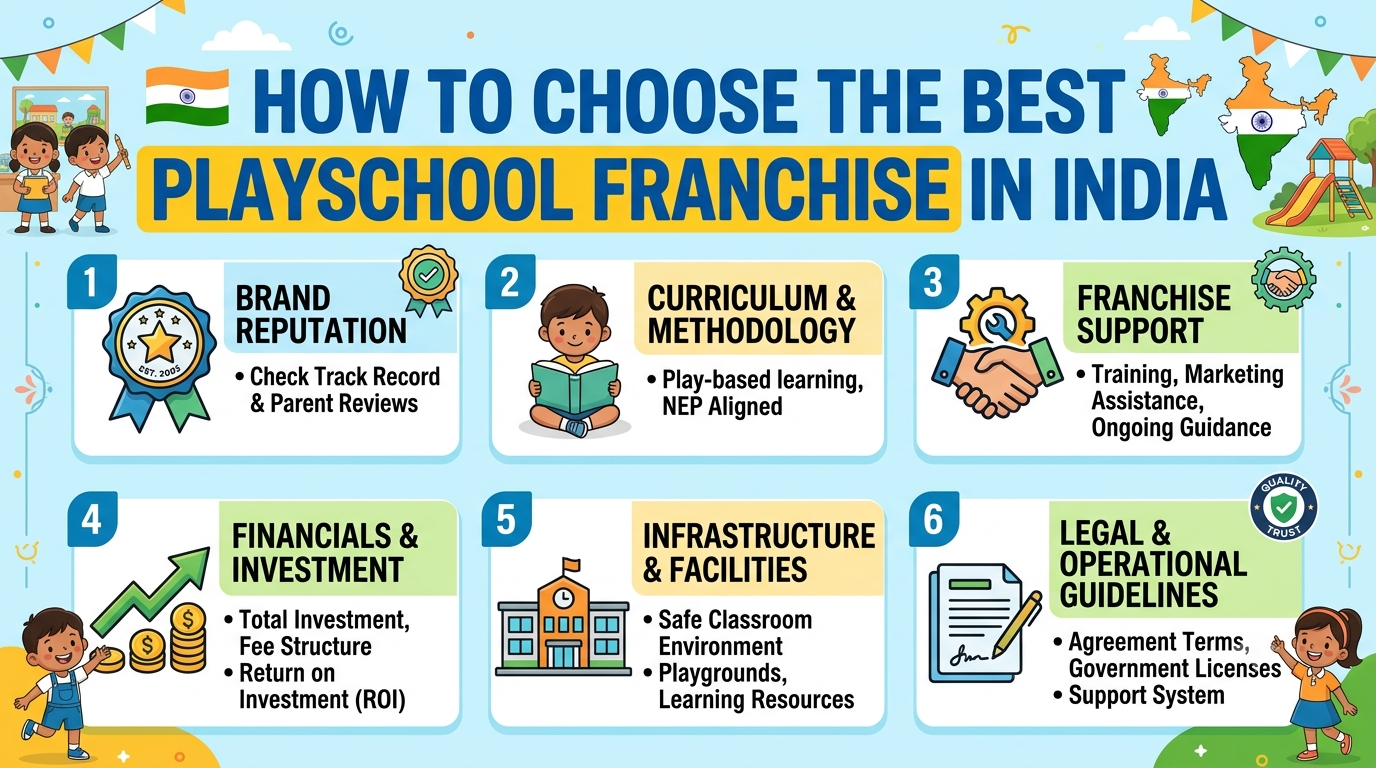
Choosing a preschool franchise is not simply about selecting a popular brand or finding the lowest franchise fee. The real decision is whether the business model can deliver quality education, sustainable admissions, operational support, and healthy long-term returns in your target location.
If you are searching for the best preschool franchise in India, this guide will help you evaluate franchise brands using practical business and education criteria. You will learn what to compare, which questions to ask franchisors, how to assess investment requirements, and what warning signs to watch before signing an agreement.
The opportunity is significant, but quality matters. UNICEF notes that the early years are a critical period for development and that high-quality early learning can improve later educational outcomes.
Voice-search answer: The best playschool franchise in India is the one that combines a credible brand, strong curriculum, practical investment, location support, teacher training, marketing assistance, transparent costs, and a business model suited to your local market.
Key Takeaways
- Do not choose a franchise based only on brand recognition or franchise cost.
- Evaluate the curriculum, teacher training, safety standards, and learning approach.
- Study the complete investment, including setup and working capital.
- Check what support the franchisor provides before and after launch.
- Speak with existing franchise partners before making a decision.
- Research local demand, competition, demographics, and property suitability.
- Read the franchise agreement carefully and understand renewal, royalty, and exit conditions.
- Build a realistic financial projection before investing.
Why Consider a Preschool Franchise in India?
India’s focus on early childhood education has created a stronger foundation for preschool and playschool businesses.
The National Education Policy (NEP) 2020 places Early Childhood Care and Education within the foundational stage and calls for universal quality ECCE as soon as possible and no later than 2030. It also recognises standalone preschools as one model for delivering ECCE.
The demand is also not purely theoretical. UNICEF’s current India data reports that 49% of children aged 36–59 months attend an early childhood education programme.
This creates opportunities for entrepreneurs who can provide a safe, structured, child-focused learning environment.
However, a growing market does not automatically mean every preschool business will succeed.
Location, fees, competition, enrolment, staff quality, parent satisfaction, operating costs, and the strength of the franchise system all influence performance.
How to Choose the Best Preschool Franchise in India
There is no single franchise that is automatically the best for every investor.
The right choice depends on your budget, city, available property, target parents, business experience, and growth objectives.
Use the following criteria to compare franchises objectively.
-
Evaluate the Brand’s Reputation
Brand recognition can make it easier to attract parents, but you should look beyond advertising.
Research:
- How long the brand has operated.
- Number of active centres.
- Geographic presence.
- Franchise partner reviews.
- Parent feedback.
- Online reputation.
- Centre-level consistency.
- Brand visibility in your target city.
A strong brand should have evidence of an established operating system rather than relying solely on promotional claims.
What should you ask?
Ask the franchisor:
- How many centres are currently operational?
- How many are company-owned versus franchised?
- How many centres opened during the last three years?
- How many franchise centres have closed?
- Can you speak with existing franchise owners?
These answers can reveal much more than a brochure.
-
Study the Preschool Curriculum
Curriculum should be one of your most important selection criteria.
A preschool should not simply prepare young children for academic examinations. Effective early learning should support areas such as:
- Language and communication
- Cognitive development
- Social-emotional development
- Physical development
- Creativity
- Problem-solving
- Independence
- School readiness
India’s education framework increasingly emphasises play- and activity-based learning during the ECCE stage. Government initiatives such as NIPUN Bharat also highlight qualified teachers, inclusive learning environments, and skills required for school readiness.
Questions to ask about curriculum
Find out:
- Who developed the curriculum?
- Is it age appropriate?
- How frequently is it updated?
- Does it use play-based learning?
- Are learning materials included?
- Are lesson plans provided?
- How is children’s progress assessed?
- Does the curriculum support different learning needs?
A good franchise should be able to explain its educational philosophy clearly.
-
Compare the Complete Investment
Franchise fees are only one part of the investment.
Your actual preschool business budget may include:
| Expense |
What to evaluate |
| Franchise fee |
Initial brand and franchise rights |
| Property |
Rent, deposit or purchase cost |
| Interiors |
Classrooms, reception and activity areas |
| Furniture |
Child-friendly furniture and storage |
| Learning materials |
Toys, books, teaching aids and equipment |
| Technology |
Software, communication and management systems |
| Branding |
Signage and centre branding |
| Staff |
Salaries and recruitment |
| Marketing |
Pre-launch and admission campaigns |
| Compliance |
Registrations, permissions and professional services |
| Working capital |
Cash required during the initial operating period |
Do not compare two franchises using only their advertised franchise fee.
One brand may charge a lower upfront fee but require greater spending on interiors, materials, technology, marketing, or recurring services.
LINK: https://www.growinnsteps.com/how-much-does-it-cost-to-start-a-playschool-franchise-in-india-2026/
-
Understand Royalty and Recurring Fees
Some investors focus heavily on the initial investment and overlook recurring expenses.
Ask whether the franchisor charges:
- Monthly royalty.
- Technology fees.
- Marketing fees.
- Curriculum renewal fees.
- Training fees.
- Annual franchise fees.
- Software charges.
- Learning-material costs.
Calculate the total cost over three to five years, not just the initial investment.
This gives you a more realistic comparison between different franchise models.
-
Check Location Selection Support
Location can make or break a preschool.
A strong franchisor should ideally help you evaluate the proposed site rather than simply approving any property.
Look at:
- Population density.
- Number of families with young children.
- Residential development.
- Nearby schools.
- Competitor preschools.
- Road accessibility.
- Parking and pickup arrangements.
- Visibility.
- Safety.
- Rental cost.
- Catchment area.
A property may look attractive but still perform poorly if the surrounding population does not match your target audience.
Ask the franchisor:
“Will your team conduct a location feasibility study before I sign the property?”
If the answer is yes, ask what factors they actually evaluate.
-
Assess Setup and Infrastructure Support
Opening a preschool involves much more than finding a building.
You may need assistance with:
- Centre layout.
- Classroom design.
- Reception area.
- Activity spaces.
- Child-friendly furniture.
- Safety features.
- Signage.
- Branding.
- Learning resources.
- Technology systems.
Find out whether the franchisor provides an actual setup team or simply gives you a design manual.
The difference can have a major impact on execution time and initial costs.
What Support Should a Preschool Franchise Provide?
The quality of franchisor support is one of the biggest differences between a franchise and an independent preschool.
-
Teacher Training and Recruitment Support
Teachers directly influence children’s experiences and parents’ perceptions.
Ask whether the franchise provides:
- Initial teacher training.
- Ongoing training.
- Classroom observation.
- Lesson-planning guidance.
- Teaching resources.
- Recruitment assistance.
- Staff performance support.
UNICEF’s India early childhood research has also highlighted the importance of programme quality, including classroom and preschool characteristics associated with children’s developmental outcomes.
A franchise with strong teacher-development systems may provide greater operational value than one that only supplies branding.
-
Evaluate Marketing and Admissions Support
Opening the centre is only the beginning.
You need a consistent admissions strategy to generate enquiries and convert them into enrolments.
Ask whether the franchisor supports:
- Website presence.
- Digital advertising.
- Social media.
- Local marketing.
- Parent events.
- Open houses.
- Admission campaigns.
- Lead management.
- Branding templates.
- Brochures and promotional materials.
Also ask who pays for marketing.
A promise of “marketing support” is not enough. Understand exactly what you receive and what you must execute yourself.
-
Examine Technology and Parent Communication
Modern parents increasingly expect convenient communication.
A franchise may provide technology for:
- Attendance.
- Fee management.
- Parent communication.
- Student records.
- Progress reports.
- Daily updates.
- Enquiry management.
- Admission tracking.
Technology is valuable when it saves staff time and improves parent experience.
Do not pay extra for technology simply because a franchise offers an app. Check whether franchise owners actually use it and whether it improves operations.
Preschool Franchise vs Independent Preschool
A franchise is not automatically better than an independent preschool.
The two models have different advantages.
| Factor |
Preschool Franchise |
Independent Preschool |
| Brand recognition |
Usually stronger initially |
Must be built |
| Curriculum |
Usually provided |
Owner develops/selects |
| Training |
Often structured |
Owner arranges |
| Setup support |
Generally available |
Self-managed |
| Marketing |
Central/local support may exist |
Fully owner-managed |
| Flexibility |
Franchise guidelines apply |
Greater flexibility |
| Initial costs |
May include franchise fee |
No franchise fee |
| Operational support |
Usually stronger |
Depends on owner’s expertise |
| Brand control |
Shared with franchisor |
Fully controlled |
Choose a franchise if you value a structured system and ongoing support.
Consider an independent model if you have strong education, operations, marketing, and brand-building capabilities and want greater control.
-
Talk to Existing Franchise Owners
This is one of the most valuable steps in your research.
Do not rely only on franchise sales representatives.
Ask existing franchisees:
- Was the promised support actually delivered?
- How long did setup take?
- Were the initial costs accurate?
- How effective was the curriculum?
- How much marketing support did they receive?
- Were admissions targets realistic?
- How responsive is the head office?
- Are recurring fees reasonable?
- Would they choose the same franchise again?
Try to speak with franchisees who operate centres similar to the one you plan to open.
Their experience can reveal practical issues that sales material may not mention.
-
Understand the Franchise Agreement
Never sign a franchise agreement simply because the opportunity looks attractive.
Have the agreement reviewed by an appropriately qualified legal professional.
Pay particular attention to:
- Franchise duration.
- Renewal conditions.
- Territory rights.
- Exclusivity.
- Royalty payments.
- Marketing obligations.
- Intellectual property.
- Curriculum ownership.
- Supplier restrictions.
- Performance requirements.
- Termination clauses.
- Transfer conditions.
- Exit provisions.
- Dispute resolution.
Also clarify what happens if you want to sell the centre or stop operating it.
Trust signal: Franchise terms vary considerably between brands. Do not rely on generic online claims about “standard” franchise agreements. Review the actual agreement offered to you.
-
Check Compliance and Safety Expectations
Preschool operators must take local requirements seriously.
Depending on the state, city, premises, and operating model, requirements can involve registrations, building and fire safety, sanitation, staff documentation, child protection practices, and other local rules.
Ask the franchisor:
- Which registrations are required?
- Who handles the application process?
- What safety standards must the centre follow?
- What staff documentation is required?
- Are child-safety protocols provided?
- Are emergency procedures included?
- Does the franchisor conduct safety audits?
The Ministry of Education’s ECCE-related framework documents also emphasise standards and quality requirements for preschool provision.
For authoritative policy context, review the National Education Policy 2020 and UNICEF India’s Early Childhood Education resources.
How to Compare Preschool Franchise Opportunities
Create a simple scoring system before making your final decision.
Rate every franchise from 1 to 5 on:
- Brand reputation
- Curriculum quality
- Initial investment
- Recurring costs
- Location support
- Teacher training
- Marketing support
- Admissions assistance
- Technology
- Existing franchisee satisfaction
- Agreement terms
- Potential for local growth
Then calculate the total score.
This prevents one attractive feature, such as a low franchise fee, from dominating your entire decision.
Red Flags to Watch Before Investing
Be cautious if a franchisor:
- Guarantees unusually high profits.
- Avoids sharing complete cost information.
- Refuses to connect you with existing franchisees.
- Pressures you to pay immediately.
- Provides unclear royalty terms.
- Cannot explain its curriculum.
- Makes vague claims about admissions.
- Has frequent centre closures.
- Offers little post-launch support.
- Does not clearly explain the franchise agreement.
A professional franchisor should welcome detailed questions.
Is a Preschool Franchise Profitable?
A preschool franchise can be profitable, but profitability is never automatic.
Your results depend on factors such as:
- Location.
- Initial investment.
- Rent.
- Student enrolment.
- Fee structure.
- Staff salaries.
- Marketing costs.
- Capacity utilisation.
- Parent retention.
- Operating efficiency.
Create three financial scenarios before investing:
Conservative scenario
Lower enrolment and higher operating costs.
Expected scenario
Realistic enrolment based on local competition and market research.
Optimistic scenario
Higher enrolment with strong retention and controlled expenses.
Calculate your expected revenue, monthly operating expenses, break-even point, and potential payback period.
Never make an investment decision based solely on a franchisor’s projected returns.
People Also Ask: Choosing a Preschool Franchise
What is the best preschool franchise in India?
The best preschool franchise in India depends on your location, investment capacity, business goals, and preferred operating model. Compare brand reputation, curriculum, support, costs, franchisee feedback, and agreement terms before choosing.
How to choose a preschool franchise?
Start by defining your budget and target location. Then compare franchise brands based on curriculum, investment, royalties, location support, teacher training, marketing, admissions assistance, technology, and franchisee satisfaction.
Why does location matter for a preschool business?
Location determines your potential catchment area, accessibility, competition, rental costs, visibility, and the number of families with young children nearby. A strong franchise cannot fully compensate for an unsuitable location.
What should I ask a preschool franchisor before investing?
Ask about total investment, franchise fees, royalties, recurring costs, territory rights, curriculum, training, marketing, admissions support, location assistance, existing franchisee performance, agreement duration, renewal, and exit terms.
How much does it cost to start a preschool franchise in India?
There is no universal cost. The investment varies by franchise, city, property, centre size, interiors, staffing, equipment, marketing, and working capital. Always request a complete written cost sheet rather than relying on the franchise fee alone.
Final Checklist Before Choosing a Preschool Franchise
Before signing anything, make sure you can answer yes to most of these questions:
- Does the brand have a credible track record?
- Is the curriculum developmentally appropriate?
- Is the investment affordable for you?
- Have you calculated recurring expenses?
- Is your location commercially suitable?
- Does the franchisor provide meaningful setup support?
- Is teacher training comprehensive?
- Is marketing support clearly defined?
- Have you spoken to existing franchisees?
- Have you reviewed the complete agreement?
- Have you prepared conservative financial projections?
- Do you understand your responsibilities as the franchise owner?
Conclusion: Choosing the Best Preschool Franchise in India
Finding the best preschool franchise in India requires more than comparing franchise fees or choosing the most recognisable name.
The strongest opportunity is the one that fits your location, investment capacity, target market, and business objectives while providing a credible curriculum and dependable operational support.
Evaluate the brand, curriculum, investment, recurring costs, location assistance, teacher training, marketing, admissions, technology, franchisee feedback, and legal terms before committing.
Most importantly, look at the opportunity from both sides: education quality and business sustainability.
A preschool is ultimately a child-focused business. Parents expect safety, care, meaningful learning, trained teachers, and reliable communication. If the franchise helps you deliver those consistently while maintaining sound unit economics, it can provide a stronger foundation for your preschool business.
Find More info:
