

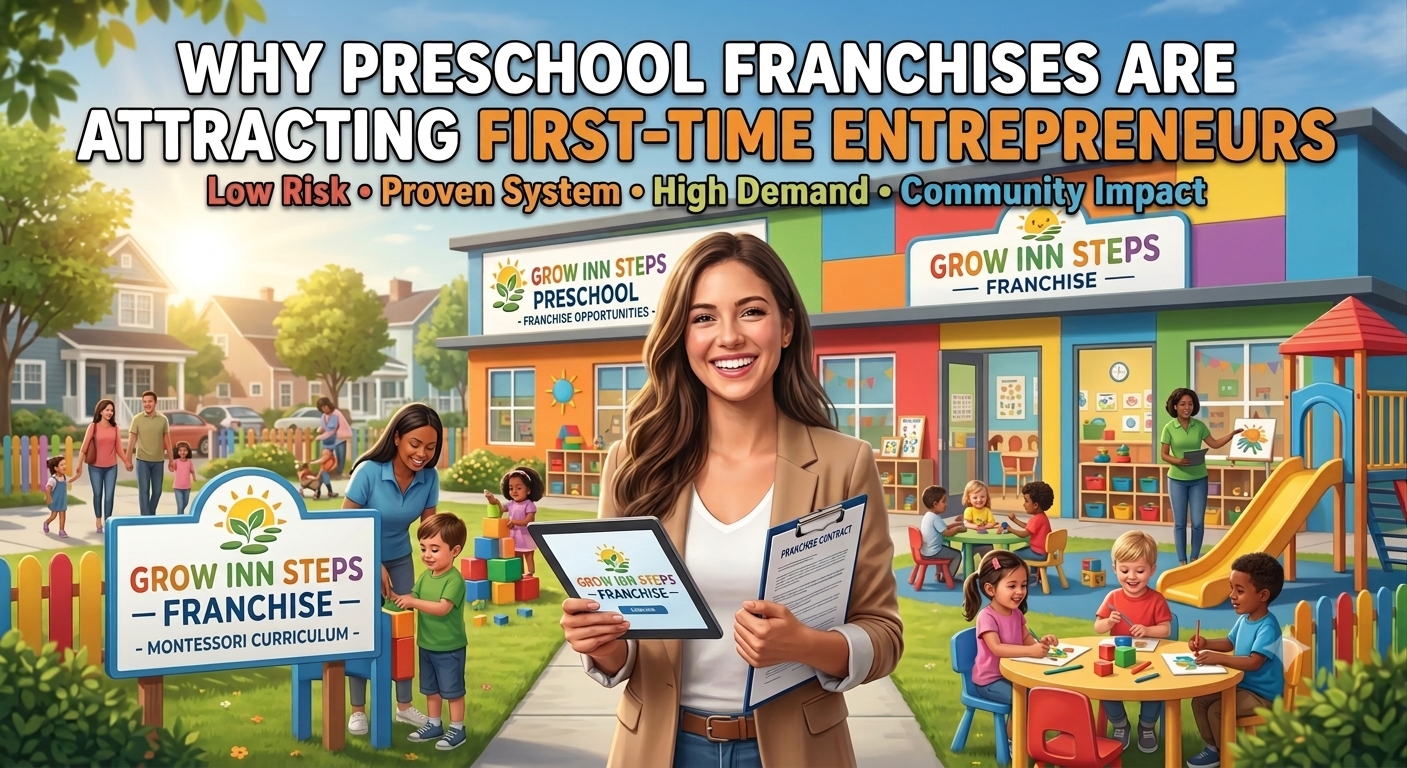
A preschool combines two characteristics that appeal to many new business owners: a service with recurring local demand and a business model that can be systematized.
Unlike businesses that require entrepreneurs to develop a completely new product, preschool franchises generally operate around an established educational framework. The franchisor may provide curriculum, training, branding, operating procedures, marketing resources, and other forms of support.
For someone without previous experience in education or entrepreneurship, that structure can reduce the complexity of getting started.
-
A Ready-Made Business Model
Building an independent preschool means creating almost everything from the ground up.
An entrepreneur may need to develop:
- A curriculum framework
- School policies
- Branding
- Admission processes
- Marketing materials
- Teacher-training systems
- Parent communication procedures
- Operational checklists
- Safety protocols
A franchise can provide many of these components as part of its established system.
This does not eliminate business risk, but it can reduce the amount of trial and error involved in launching the centre.
-
Established Brand Recognition
Parents tend to be careful when choosing an early-learning centre because they are trusting the school with their child’s first structured educational experience.
A recognizable preschool brand can give a new centre an initial credibility advantage compared with an unknown independent school.
However, brand recognition should never be the only consideration. Parents should still evaluate the individual centre because execution can vary significantly between locations.
-
Training for New Entrepreneurs
One of the biggest challenges for first-time entrepreneurs is not necessarily funding—it is knowing what to do.
A good franchisor can provide guidance on areas such as:
- Centre setup
- Staff recruitment
- Teacher training
- Curriculum implementation
- Admissions
- Parent engagement
- Local marketing
- Centre operations
This support can be particularly valuable for an entrepreneur entering the education sector for the first time.
How Preschool Franchise Support Helps First-Time Business Owners
The real value of a franchise is not simply the logo displayed outside the school.
The stronger proposition is the support ecosystem behind the centre.
Location and Centre Setup
Location can have a major influence on a preschool’s ability to attract families.
A franchisor may help entrepreneurs evaluate factors such as:
- Residential density
- Target-parent demographics
- Competition
- Accessibility
- Visibility
- Property suitability
- Local demand
The entrepreneur still needs to conduct proper due diligence, but expert guidance can make the decision more structured.
Curriculum and Learning Resources
Developing an age-appropriate curriculum requires knowledge of early childhood development, classroom practices, learning objectives, and activity planning.
A franchise may provide a standardized curriculum along with teaching resources and lesson-planning frameworks.
For parents, this can be beneficial when the curriculum translates into meaningful classroom experiences rather than simply attractive worksheets and promotional claims.
Teacher Recruitment and Training
Teachers directly influence the quality of a child’s preschool experience.
Franchisors may support franchise owners with recruitment guidelines, induction programs, classroom training, and ongoing professional development.
First-time entrepreneurs benefit because they do not have to develop a teacher-training system entirely on their own.
Marketing and Admissions Support
A new preschool needs local visibility before it can build enrollment.
Franchise systems may offer:
- Digital marketing templates
- Social media creatives
- Admission campaigns
- Website support
- Local marketing strategies
- Promotional materials
- Lead-generation guidance
The franchise owner can then adapt these resources to the local market.
Why Preschool Franchises Can Be Easier to Understand Than Starting From Scratch
A first-time entrepreneur often faces uncertainty around basic business questions:
How much space is needed? Who should be hired? What should the classrooms look like? How should parents be approached? What should the admission process include?
A franchise operating manual and support team can provide a starting framework for answering these questions.
That structure can make entrepreneurship feel more manageable.
However, entrepreneurs should understand an important distinction:
A structured business model reduces uncertainty; it does not eliminate business risk.
Enrollment, rent, salaries, competition, local regulations, parent satisfaction, and operational discipline still determine the financial performance of an individual centre.
What Makes a Preschool Franchise Attractive to New Entrepreneurs?
Several factors make this sector particularly appealing.
Lower Product Development Burden
A traditional startup may need to develop, test, improve, and market a product.
A preschool franchise typically starts with an existing educational and operational framework.
The entrepreneur’s focus shifts toward execution, local management, enrollment, staff quality, and customer experience.
Recurring Revenue Potential
Preschools generally operate through recurring fee structures rather than relying on one-time transactions.
This can make revenue planning more understandable once enrollment becomes stable.
That said, recurring revenue should not be confused with guaranteed profitability. A centre needs sufficient enrollment to cover rent, salaries, utilities, marketing, materials, maintenance, and other operating expenses.
Growing Focus on Early Childhood Education
Parents increasingly recognize the importance of early learning, social development, communication, independence, and school readiness.
This creates opportunities for well-managed preschool centres that provide a genuinely strong early-learning experience.
For entrepreneurs, the opportunity lies not simply in opening a centre but in building trust with families in the local community.
Why Parents Should Pay Attention to the Preschool Franchise Trend
The rise of preschool franchises is not only a business story.
It directly affects parents.
When more franchise-backed centres enter local markets, parents may have more choices. But more choices also make comparison more important.
Parents should evaluate the actual preschool, not just the franchise name.
Check the Teacher-Child Interaction
Observe how teachers communicate with children.
Do teachers listen patiently? Do children appear comfortable asking questions? Are activities interactive?
These observations often reveal more about classroom quality than a brochure does.
Evaluate Safety Standards
Ask about:
- Entry and exit procedures
- CCTV policies
- Fire safety
- First-aid availability
- Child pickup authorization
- Staff background verification
- Emergency procedures
- Classroom supervision
Safety should be a non-negotiable part of the decision.
Understand the Curriculum
Ask the preschool to explain what children actually do during a typical day.
A good early-learning program should balance structured activities with play, movement, communication, creativity, exploration, and social interaction.
Speak With Existing Parents
One of the most useful steps is to talk to parents whose children already attend the centre.
Ask about:
- Teacher communication
- Cleanliness
- Staff responsiveness
- Fee transparency
- Daily routines
- Child adjustment
- Overall parent experience
Real-world feedback can reveal operational strengths and weaknesses that marketing material does not show.
What First-Time Entrepreneurs Should Check Before Buying a Preschool Franchise
Entrepreneurs should avoid choosing a franchise purely because it has a familiar name.
-
Total Investment
Calculate the complete investment rather than looking only at the advertised franchise fee.
Consider:
- Franchise fee
- Property deposit
- Rent
- Interiors
- Furniture
- Learning materials
- Technology
- Staff salaries
- Marketing
- Licenses and compliance
- Working capital
A realistic financial plan should also account for the time required to build enrollment.
-
Franchise Agreement
Read the agreement carefully.
Pay particular attention to:
- Contract duration
- Renewal conditions
- Royalty structure
- Marketing fees
- Territory rights
- Exit provisions
- Training obligations
- Branding requirements
- Renewal costs
Professional legal advice can be worthwhile before signing a long-term agreement.
-
Actual Franchisor Support
Do not accept vague promises such as “complete support.”
Ask for specifics.
Who helps with recruitment? How long does training last? Who supports marketing? Is location evaluation included? How frequently does the franchisor conduct centre audits?
The answers can reveal how much practical support the franchise actually provides.
-
Existing Franchisee Feedback
Talk to existing franchise owners.
Ask them about:
- Initial setup
- Training
- Marketing support
- Lead generation
- Operational assistance
- Hidden expenses
- Communication with the franchisor
- Enrollment experience
Existing franchisees can provide insights that sales presentations cannot.
Common Mistakes First-Time Preschool Franchise Investors Make
Choosing a Brand Instead of a Business Model
A popular brand does not automatically mean a profitable centre.
The location, operating costs, enrollment potential, staff quality, and local competition matter enormously.
Underestimating Working Capital
New entrepreneurs sometimes spend heavily on interiors and launch activities while keeping too little money for ongoing expenses.
Working capital should cover the early period when enrollment is still developing.
Assuming the Franchisor Will Run the Centre
A franchise provides systems and support, but the owner remains responsible for execution.
Poor staff management, weak parent communication, inadequate marketing, or careless financial management can damage a centre regardless of its franchise brand.
Focusing Only on Admissions
Enrollment is important, but retention matters too.
A preschool that consistently delivers a positive parent and child experience has a better foundation for referrals and long-term local reputation.
How Parents Can Identify a High-Quality Franchise Preschool
Parents can use a simple five-point assessment.
- Environment: Is the centre clean, welcoming, safe, and child-friendly?
- Teachers: Are educators trained, attentive, patient, and engaged?
- Learning: Does the program encourage play, creativity, communication, exploration, and age-appropriate development?
- Communication: Does the school communicate clearly with parents about routines, progress, activities, and concerns?
- Trust: Do the school’s practices match its promises?
This approach helps parents separate genuine quality from marketing.
Is a Preschool Franchise a Good Choice for First-Time Entrepreneurs?
It can be—but only when the entrepreneur approaches it as an operating business rather than a passive investment.
The strongest candidates usually combine:
- Adequate capital
- Strong local market understanding
- Willingness to manage people
- Interest in education
- Consistent marketing
- Operational discipline
- Patience during the enrollment-building phase
A franchise can provide the framework. The entrepreneur still has to execute it effectively.
Why Preschool Franchises Are Attracting First-Time Entrepreneurs: Final Takeaway
The growing interest in preschool franchises comes down to a simple proposition: first-time entrepreneurs can enter the early education sector with an established framework instead of building every business system themselves.
Branding, curriculum, training, marketing resources, operational guidance, and ongoing support can make the learning curve more manageable.
But neither entrepreneurs nor parents should judge a preschool franchise by its brand name alone.
For entrepreneurs, the priority should be evaluating investment, support, agreement terms, location potential, operating costs, and franchisee feedback.
For parents, the priority should remain teacher quality, safety, curriculum, child experience, communication, and the actual performance of the individual centre.
When those factors align, a preschool franchise can create a structured business opportunity while helping deliver a consistent early-learning experience for families.
Grow Inn Steps Preschool Franchise: An Option for First-Time Entrepreneurs
For entrepreneurs exploring the preschool franchise market in India, Grow Inn Steps Preschool Franchise is an option worth evaluating. The franchise model is designed to help aspiring education entrepreneurs enter the preschool sector with a structured framework rather than developing every system independently.
For a first-time entrepreneur, this type of support can be particularly valuable because opening a preschool involves much more than finding a property and hiring teachers. Entrepreneurs need to consider centre setup, curriculum implementation, staff training, branding, marketing, admissions, parent communication, and day-to-day operations.
Why Consider a Grow Inn Steps Preschool Franchise?
A key attraction for new entrepreneurs is the opportunity to operate under an established preschool framework.
Instead of starting completely from scratch, prospective franchise owners can evaluate the support available across important areas of the business, including:
- Centre setup and infrastructure guidance
- Curriculum and learning resources
- Teacher training and development
- Branding and marketing support
- Admissions and lead-generation strategies
- Operational guidance
- Parent engagement processes
The exact scope of support, investment requirements, franchise terms, and services should always be confirmed directly with Grow Inn Steps before making an investment decision.
Frequently Asked Questions
-
Why are preschool franchises attracting first-time entrepreneurs?
Preschool franchises attract first-time entrepreneurs because they can provide an established business model, curriculum, training, branding, marketing resources, and operational support.
-
Is a preschool franchise profitable for a first-time entrepreneur?
A preschool franchise can be profitable, but profitability is not guaranteed. Location, enrollment, fees, operating costs, staff management, marketing, and the quality of execution strongly influence financial performance.
-
What support does a preschool franchise usually provide?
Support can include location assistance, centre setup, curriculum, teacher training, marketing, admissions guidance, operational systems, and ongoing franchise support. The exact services vary by franchisor.
-
What should parents check before choosing a franchise preschool?
Parents should assess teacher quality, child safety, classroom environment, curriculum, hygiene, communication, fees, daily routines, and feedback from existing parents.
-
Is a preschool franchise better than starting an independent preschool?
A franchise can offer more structured support and established systems, while an independent preschool provides greater flexibility. The better option depends on the entrepreneur’s experience, resources, goals, and willingness to build systems independently.
