

-
Introduction: Understanding Preschool Franchise ROI
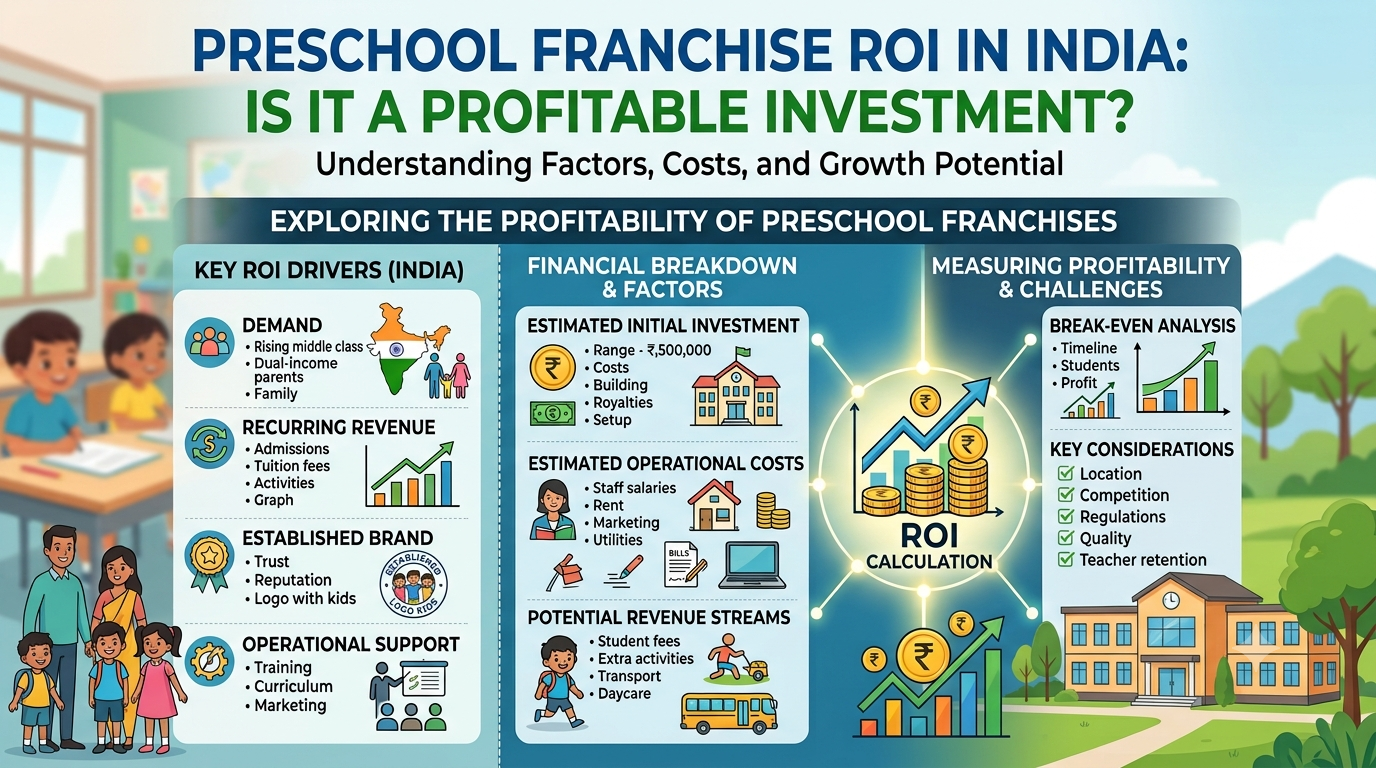
Starting a preschool can be an attractive business opportunity for entrepreneurs who want to build a venture in the education sector. However, before investing, it is important to understand the financial potential, costs, risks, and long-term sustainability of the business. This is where Preschool Franchise ROI becomes an important consideration.
Preschool Franchise ROI refers to the return an entrepreneur can potentially generate from the capital invested in a preschool franchise. It helps prospective franchise owners evaluate whether the expected profits justify the initial preschool franchise investment and ongoing operating expenses. Looking at ROI alongside the payback period, cash flow, and profitability provides a more realistic picture of the business opportunity.
The growing interest in the preschool franchise business in India is driven by increasing awareness of early childhood education and demand for structured learning environments. A franchise model can also provide entrepreneurs with an established brand framework, curriculum, training, marketing assistance, and operational guidance, depending on the franchisor.
However, preschool franchise profitability is not determined by the brand alone. Factors such as location, student enrolments, fee structure, rent, staffing costs, marketing expenses, centre capacity, and day-to-day business management can significantly influence financial performance. A well-positioned centre with strong enrolment and efficient cost management may have very different results from a centre operating in a highly competitive or expensive location.
Entrepreneurs should therefore avoid evaluating a franchise based solely on projected earnings or attractive ROI figures. Instead, they should carefully assess the total investment, expected revenue, recurring expenses, break-even point, market demand, franchise support, and potential risks before making a decision.
Understanding Preschool Franchise ROI from the beginning allows investors to make more informed financial decisions and determine whether a particular preschool franchise opportunity aligns with their business goals and investment capacity.
-
What Is Preschool Franchise ROI?
Preschool Franchise ROI stands for Return on Investment and is a financial measure used to understand how much profit a preschool franchise generates compared with the amount of money invested in the business. In simple terms, it helps an entrepreneur answer an important question: “How much am I earning compared with what I invested?”
The preschool franchise return on investment should be evaluated using realistic revenue and expense estimates rather than relying only on projected sales figures. An entrepreneur needs to consider the initial franchise investment, property and setup costs, staff salaries, marketing expenses, rent, utilities, maintenance, and other operating costs before calculating the actual return.
The Preschool Franchise ROI Formula
The basic formula for calculating ROI is:
ROI = (Net Profit ÷ Total Investment) × 100
For example, suppose an entrepreneur invests ₹30 lakh to establish a preschool franchise and generates an estimated ₹9 lakh in annual net profit.
ROI = (₹9 lakh ÷ ₹30 lakh) × 100 = 30%
This means the hypothetical annual return is 30% of the initial investment. However, this example is for illustration only. Actual preschool business ROI can vary considerably depending on location, enrolment, fees, operating expenses, and business performance.
Revenue vs Gross Profit vs Net Profit
Understanding these terms is essential when evaluating Preschool Franchise ROI.
Revenue is the total money generated by the preschool through tuition fees, admission fees, daycare, activities, and other services before expenses are deducted.
Gross profit is the amount remaining after subtracting direct costs associated with delivering the preschool’s services from revenue.
Net profit is what remains after accounting for all relevant business expenses, including rent, salaries, utilities, marketing, maintenance, administrative expenses, and other operating costs. Net profit is particularly important when calculating ROI because it provides a more realistic picture of the money generated by the business.
ROI vs Break-Even Point
The break-even point is the stage at which total revenue equals total costs. At this point, the preschool is neither making a profit nor generating a loss.
For a preschool franchise, reaching break-even generally depends on factors such as student enrolment, fee levels, fixed expenses, variable costs, and centre capacity. Understanding the break-even point helps an entrepreneur determine how much business activity is required before the centre starts generating an operating profit.
ROI vs Payback Period
ROI and payback period measure different aspects of financial performance.
ROI tells you how much return the investment generates relative to the capital invested.
Payback period tells you approximately how long it may take to recover the original investment from the business’s profits or cash flows.
For example, if a hypothetical preschool requires a ₹30 lakh investment and generates ₹6 lakh in annual net profit, a simple payback calculation would be:
Payback Period = ₹30 lakh ÷ ₹6 lakh = 5 years
The actual payback period can vary because profits and cash flows may change from year to year.
Why These Metrics Matter for Preschool Business ROI
Looking at only one financial figure can give an incomplete picture of a franchise opportunity. A prospective franchise owner should evaluate preschool business ROI alongside:
- Revenue – How much the centre generates.
- Gross profit – What remains after direct costs.
- Net profit – What remains after operating expenses.
- ROI – The return generated relative to the investment.
- Break-even point – When revenue covers total costs.
- Payback period – How long it may take to recover the initial investment.
Together, these metrics provide a more comprehensive view of the financial potential of a preschool franchise. Before investing, entrepreneurs should create conservative, realistic projections and assess how changes in enrolment, fees, rent, salaries, and other expenses could affect the expected Preschool Franchise ROI.
-
Understanding Preschool Franchise Investment
Before starting a preschool franchise, entrepreneurs need to understand the different expenses involved in setting up and operating the centre. A preschool franchise investment is not limited to the franchise fee. It can include property-related expenses, infrastructure, learning resources, staffing, marketing, technology, and sufficient working capital to manage the business during its initial months.
Understanding each cost component helps prospective franchise owners create a realistic budget and evaluate the potential financial requirements of the business.
Major Components of a Preschool Franchise Investment
1. Franchise Fee
The franchise fee is the amount paid to the franchisor for the right to operate under its established brand and use its business systems, curriculum, resources, and other agreed benefits. The fee and inclusions vary between franchise brands, so entrepreneurs should carefully review the franchise agreement.
2. Property Deposit and Rent
Property can be one of the major expenses when establishing a preschool. Depending on the lease arrangement, the entrepreneur may need to budget for a security deposit, advance rent, brokerage, and ongoing monthly rent.
The cost can vary significantly depending on the city, neighbourhood, property size, and location.
3. Interior Setup
A preschool requires a child-friendly, functional, and safe environment. Interior expenses may include classroom development, flooring, walls, reception areas, activity spaces, storage, lighting, washrooms, and other infrastructure.
The amount invested in interiors will depend on the centre’s size, design standards, and facilities.
4. Furniture
Classrooms require age-appropriate furniture such as tables, chairs, shelves, storage units, teacher furniture, and reception furniture. Outdoor or activity areas may also require additional equipment.
5. Learning Materials
Learning resources form an important part of preschool infrastructure. Depending on the curriculum and franchise model, these may include books, educational toys, activity materials, teaching aids, puzzles, art supplies, and other classroom resources.
6. Safety Equipment
A preschool should have appropriate safety measures to create a secure environment for children. Expenses may include CCTV systems, fire-safety equipment, first-aid supplies, child-safe fixtures, access controls, and other required safety provisions.
Local regulations and the specific property may determine additional requirements.
7. Branding and Signage
Branding expenses can include exterior signage, reception branding, classroom displays, promotional materials, and other visual elements required by the franchise.
Strong and consistent branding can also help create a professional first impression for prospective parents.
8. Staff Recruitment
Staffing is an important part of both the initial setup and ongoing operating costs. Entrepreneurs may need to budget for recruitment, salaries, administrative staff, teachers, helpers, and other centre personnel depending on the size and operating model.
9. Teacher Training
Teacher training may be provided or supported by the franchisor, depending on the franchise agreement. Entrepreneurs should understand whether training costs are included in the franchise package or charged separately.
Well-trained teachers are essential for implementing the curriculum and maintaining a consistent learning experience.
10. Marketing
A new preschool needs marketing to generate awareness and attract prospective families. Initial marketing expenses may include digital advertising, local promotions, launch campaigns, social media marketing, brochures, events, and community outreach.
Marketing requirements can change significantly depending on the local competition and the centre’s admission targets.
11. Technology
Technology expenses may include computers, tablets, internet connectivity, school-management software, communication tools, CCTV infrastructure, digital learning resources, and other systems used for centre administration.
The exact requirements depend on the franchise’s operational and technology framework.
12. Working Capital
Working capital is one of the most important parts of a preschool franchise investment. It provides a financial cushion for recurring expenses during the early stages of the business, when enrolments may still be developing.
Working capital may be used for rent, salaries, utilities, marketing, maintenance, supplies, and other operating expenses.
What Is the Typical Preschool Franchise Cost in India?
There is no single preschool franchise cost that applies to every franchise or every city in India. The total investment can vary substantially depending on the business model and the scale at which the centre is established.
Some of the key factors affecting preschool franchise cost include:
- City: Property and operating costs differ between cities.
- Location: Prime residential or high-visibility areas may command higher rents.
- Centre size: Larger centres generally require more infrastructure, furniture, staff, and resources.
- Brand: Different franchise brands have different fees, infrastructure standards, and support models.
- Property type: A rented, leased, or owned property can result in different financial requirements.
- Infrastructure: The condition of the property and the level of renovation required can significantly affect setup costs.
- Facilities: Additional classrooms, play areas, daycare facilities, technology, and other amenities can increase investment.
- Business model: A traditional preschool, preschool with daycare, or larger early-learning centre may have different investment requirements.
Therefore, entrepreneurs should avoid relying on a single advertised investment figure when evaluating a franchise. Instead, they should request a complete cost breakdown from the franchisor and separately estimate property, setup, staffing, marketing, recurring expenses, and working-capital requirements.
A detailed understanding of the preschool franchise investment gives entrepreneurs a clearer foundation for calculating potential profitability, break-even timelines, and Preschool Franchise ROI before committing capital.
-
What Determines Preschool Franchise Profitability?
The preschool franchise profitability of a centre depends on much more than the brand name or the initial investment. Factors such as location, student enrolment, fee structure, operating expenses, and the level of franchisor support can all influence how much revenue a centre generates and how much profit it ultimately retains.
For entrepreneurs evaluating a profitable preschool franchise, it is important to look at the complete business model rather than focusing only on projected revenue or preschool franchise earnings. A centre with strong enrolment and controlled expenses may perform differently from one operating in an expensive location with limited demand.
4.1 Location
Location is one of the most important factors affecting preschool profitability. A well-positioned centre can have better access to its target audience and potentially generate stronger enrolment.
Key location factors include:
- Residential catchment: Areas with a suitable concentration of families with young children can provide a stronger potential customer base.
- Accessibility: The centre should be convenient for parents to reach, with suitable roads, entrances, parking or drop-off arrangements where possible.
- Visibility: A clearly visible location can improve local awareness and make it easier for parents to identify the preschool.
- Competition: Understanding the number, positioning, fees, and reputation of nearby preschools helps entrepreneurs assess the local market.
- Family demographics: Household characteristics, the number of young children, and local preferences can influence demand for preschool services.
Choosing a location based solely on low rent can be risky. Entrepreneurs should evaluate the relationship between property cost, potential demand, accessibility, and long-term business viability.
4.2 Student Enrolment
Student enrolment has a direct impact on preschool revenue. Since many preschool expenses are fixed or semi-fixed, maintaining healthy enrolment can be important for improving profitability.
Important enrolment factors include:
- Number of students: More students can increase revenue, provided the centre has sufficient capacity and staffing.
- Admission conversion: Converting enquiries and leads into confirmed admissions is essential for building enrolment.
- Retention: Maintaining positive relationships with parents and delivering a strong learning experience can support student retention.
- Classroom capacity: The centre needs to balance student numbers with available classrooms, staff, safety requirements, and educational quality.
A preschool should focus not simply on increasing admissions but on achieving sustainable enrolment while maintaining the quality of care and education.
4.3 Fee Structure
The fee structure determines how much revenue the preschool can generate from each enrolled student. However, fees should be aligned with the local market, target parents, services offered, and the centre’s positioning.
Potential revenue components include:
- Admission fees
- Tuition fees
- Annual charges
- Activity or material fees
- Daycare fees, where applicable
A higher fee does not automatically mean higher profitability. If pricing is significantly above comparable local options, it may affect enquiries and admissions. Entrepreneurs should therefore assess competitors and local demand before establishing the fee structure.
4.4 Operating Expenses
Managing expenses effectively is essential for improving preschool franchise profitability. Even a centre with strong revenue can have limited net profit if its operating costs are too high.
Major operating expenses can include:
- Rent: Property costs can represent a significant recurring expense.
- Salaries: Teachers, helpers, administrators, and other employees contribute to ongoing staffing costs.
- Utilities: Electricity, water, internet, and other essential services add to monthly expenses.
- Marketing: Digital advertising, local promotions, events, and lead-generation activities may be required to maintain admissions.
- Maintenance: Regular maintenance helps keep the centre safe, functional, and presentable.
- Learning materials: Educational resources and classroom supplies require ongoing budgeting.
The goal should not simply be to minimize expenses. Cutting essential spending on teachers, safety, learning resources, or parent experience can negatively affect the quality and reputation of the centre.
4.5 Brand and Support
The franchisor’s brand and support system can also influence the performance of a preschool franchise. An established brand may provide a structured framework that helps entrepreneurs avoid some of the challenges involved in building an independent preschool from scratch.
Important areas to evaluate include:
- Brand recognition: A recognised brand may help establish initial awareness among parents, although local marketing remains important.
- Curriculum: A structured curriculum can provide teachers and franchisees with an established educational framework.
- Training: Teacher and franchisee training can help teams understand the curriculum, processes, and operating standards.
- Marketing support: Franchisors may provide marketing resources, campaign guidance, branding materials, or digital support depending on the agreement.
- Operational guidance: Ongoing guidance can help franchisees manage admissions, staff, parent communication, centre operations, and other business processes.
However, franchise support should not be viewed as a guarantee of profitability. The actual preschool franchise earnings achieved by a centre will depend on local demand, execution, enrolment, pricing, expenses, and the entrepreneur’s ability to manage the business effectively.
The Bottom Line
A profitable preschool franchise is typically built through a combination of the right location, sustainable enrolment, appropriate pricing, disciplined expense management, strong parent relationships, and effective operational execution.
Before investing, entrepreneurs should analyse these factors together and create realistic financial projections. This provides a much better basis for estimating potential preschool franchise earnings and evaluating whether the opportunity can deliver the desired level of preschool franchise profitability.
-
Preschool Franchise Earnings: Where Does the Revenue Come From?
When evaluating preschool franchise earnings, entrepreneurs should look beyond basic tuition revenue and understand the different income streams available within the preschool and early-learning business model. While tuition is generally a core source of revenue, additional services can create opportunities to generate revenue throughout the year.
The exact revenue mix will depend on the franchise model, centre capacity, local demand, pricing, facilities, and the services offered. These revenue streams can also influence overall preschool franchise profitability when they are managed efficiently and align with what parents in the local market are looking for.
- Preschool Tuition
Preschool tuition is typically one of the primary sources of revenue. Parents pay fees for their children to participate in the centre’s regular preschool program.
The total tuition revenue depends on factors such as:
- Number of enrolled students
- Fee structure
- Number of classrooms
- Age groups offered
- Centre capacity
- Student retention
Maintaining consistent enrolment while delivering a high-quality learning experience can help create a more stable revenue base.
- Admission Fees
Some preschool models charge an admission or registration fee when a child joins the centre. This can contribute to the revenue generated during the admission cycle.
Entrepreneurs should clearly understand how admission fees are structured and whether they are included in the franchise’s recommended pricing model.
- Annual Fees
Annual charges may cover specific resources, activities, administration, learning materials, events, or other services provided throughout the academic year.
The structure and amount of these fees can vary depending on the preschool’s offerings and local market practices.
- Daycare
Daycare can provide an additional revenue stream for preschool centres that offer childcare beyond regular preschool hours.
Working parents may look for a convenient combination of preschool and daycare services. Where demand exists and the franchise model permits it, daycare can increase the centre’s overall revenue potential.
However, daycare also requires appropriate staffing, infrastructure, safety measures, and operating procedures, which should be considered when evaluating its financial contribution.
- Extended Care
Extended-care services can cater to parents who require childcare before or after standard preschool hours.
Depending on the local market, centres may charge additional fees for extended hours. The additional revenue should be evaluated against the extra staffing, utilities, supervision, and operational costs involved.
- Summer Camps
Summer camps can provide an opportunity to generate seasonal revenue when regular preschool schedules change.
Age-appropriate activities may include:
- Arts and crafts
- Storytelling
- Music
- Games
- Creative activities
- Sports and movement
- Educational experiences
The success of a summer camp depends on local demand, pricing, marketing, available facilities, and the quality of the program.
- Activity Programs
Preschools may offer additional activity-based programs designed to support children’s creativity, physical development, communication, and social skills.
Examples can include:
- Art and craft
- Music
- Dance
- Movement activities
- Storytelling
- Educational games
If these programs are offered for an additional fee, they can contribute to overall centre revenue.
- Workshops
Workshops can create occasional revenue opportunities while providing additional experiences for children and families.
Depending on the centre and its audience, workshops may focus on topics such as creativity, communication, arts, music, parenting, or age-appropriate educational activities.
The workshop model should be designed around genuine local demand rather than simply adding services to increase revenue.
- Enrichment Programs
Enrichment programs can provide additional learning experiences beyond the core preschool curriculum. These may include language activities, creative learning, music, movement, or other age-appropriate programs.
Such services can potentially increase revenue per enrolled family while strengthening the overall value proposition of the centre.
How Additional Services Can Improve Preschool Franchise Earnings
Additional services can potentially increase preschool franchise earnings by creating new revenue opportunities beyond regular tuition. They may also help a centre serve different parent requirements throughout the year.
For example, a preschool that combines its core program with daycare, extended care, camps, or enrichment activities may have more than one source of revenue. However, additional revenue does not automatically translate into additional profit.
Each service comes with its own costs, including:
- Additional staff
- Facilities
- Materials
- Utilities
- Marketing
- Administration
- Safety and supervision
Therefore, entrepreneurs should evaluate both additional revenue and additional expenses when determining whether a service can improve preschool franchise profitability.
Choosing the Right Revenue Mix
The strongest revenue model is not necessarily the one with the highest number of services. Instead, entrepreneurs should focus on services that match the needs of families in their target location.
Before introducing an additional service, consider:
- Is there sufficient local demand?
- Does the centre have the required space?
- Can existing staff manage the program?
- What additional costs will be involved?
- Will parents see genuine value in the service?
- Does the franchise agreement permit the service?
- What is the expected contribution to revenue and profit?
Ultimately, preschool franchise earnings depend on sustainable enrolment, appropriate pricing, efficient operations, and the ability to deliver services that parents genuinely value. A diversified revenue model can support preschool franchise profitability, but every additional service should be evaluated based on its own revenue potential, costs, demand, and operational requirements.
-
How to Calculate Preschool Franchise Return on Investment
Understanding the preschool franchise return on investment is essential for entrepreneurs who want to evaluate whether the expected financial returns justify the amount invested in establishing and operating a preschool franchise. ROI provides a simple way to compare the potential profit generated by a business with the capital invested in it.
However, ROI should always be calculated using realistic financial assumptions. Actual Preschool Franchise ROI can vary depending on factors such as location, enrolment, fee structure, rent, staffing costs, marketing expenses, operating efficiency, and the time required to build a stable student base.
Preschool Franchise ROI Formula
The basic formula is:
Preschool Franchise ROI = (Annual Net Profit ÷ Total Initial Investment) × 100
To understand how this works, consider the following hypothetical example.
Hypothetical Preschool Franchise ROI Example
Suppose an entrepreneur establishes a preschool franchise with the following estimated financial figures:
| Financial Metric | Hypothetical Amount |
| Initial Investment | ₹30 lakh |
| Annual Revenue | ₹24 lakh |
| Annual Operating Expenses | ₹15 lakh |
| Estimated Annual Net Profit | ₹9 lakh |
The estimated annual net profit is calculated as:
Annual Revenue − Annual Operating Expenses = Annual Net Profit
Therefore:
₹24 lakh − ₹15 lakh = ₹9 lakh
Now apply the ROI formula:
ROI = (₹9 lakh ÷ ₹30 lakh) × 100
ROI = 30%
Based on these hypothetical assumptions, the estimated preschool business ROI would be 30% per year.
Important: This is a hypothetical illustration designed to demonstrate how ROI is calculated. It is not a guaranteed return or expected result for any particular preschool franchise. Actual profitability and ROI can be higher or lower depending on the business’s performance and market conditions.
How to Calculate the Payback Period
ROI tells you the return generated relative to the investment, while the payback period estimates how long it may take to recover the original investment.
The basic formula is:
Payback Period = Initial Investment ÷ Annual Net Profit
Using the same hypothetical example:
Payback Period = ₹30 lakh ÷ ₹9 lakh
Payback Period ≈ 3.33 years
Therefore, if the business consistently generated ₹9 lakh in annual net profit, the simple payback period would be approximately 3.3 years.
In reality, the calculation may take longer or shorter because preschool revenue and expenses can change from year to year. Enrolment may increase gradually, expenses may rise, and the centre may require additional investment as it grows.
Why Entrepreneurs Should Look Beyond ROI
While preschool franchise return on investment is an important metric, it should not be the only factor used to evaluate an opportunity.
Entrepreneurs should also examine:
- Total initial investment
- Monthly operating expenses
- Student enrolment assumptions
- Revenue per student
- Net profit margin
- Break-even point
- Payback period
- Working-capital requirements
- Recurring franchise fees
- Local competition
- Long-term growth potential
Evaluating these metrics together provides a more complete picture of potential Preschool Franchise ROI.
Create Conservative Financial Projections
Before investing, entrepreneurs should prepare multiple scenarios rather than relying on a single projection. For example:
- Conservative scenario: Lower enrolment and higher operating costs
- Expected scenario: Realistic enrolment and normal operating expenses
- Optimistic scenario: Strong enrolment and efficient cost management
This approach can help investors understand how changes in enrolment, pricing, rent, salaries, and other expenses could affect preschool business ROI.
Ultimately, calculating Preschool Franchise ROI is about understanding the relationship between the capital invested, revenue generated, expenses incurred, and profit retained. A realistic financial model can help entrepreneurs make better-informed decisions before committing to a preschool franchise opportunity.
-
Preschool Franchise ROI vs Payback Period
When evaluating a preschool franchise opportunity, Preschool Franchise ROI is an important financial metric, but it should not be considered in isolation. ROI tells an entrepreneur how much profit the investment generates relative to the capital invested, while the payback period focuses on how long it may take to recover the initial investment.
Understanding both metrics, along with cash flow, break-even point, annual profit, and long-term profitability, gives investors a more complete view of the potential preschool franchise return on investment.
Why Investors Should Look Beyond ROI
A high ROI percentage may look attractive, but it does not always tell the complete story. Two preschool franchises can have similar ROI percentages while having very different investment amounts, cash flows, operating costs, and payback periods.
For example, a franchise requiring a smaller initial investment may generate a strong ROI but relatively modest absolute profit. A premium centre may require substantially more capital but have greater revenue and profit potential if it achieves strong enrolment.
Therefore, investors should evaluate preschool franchise profitability using multiple financial indicators rather than focusing on one percentage.
- Break-Even Point
The break-even point is reached when the centre’s total revenue equals its total operating costs. At this stage, the business has covered its expenses but has not yet generated a profit.
For a preschool, the break-even point can depend on:
- Monthly rent
- Staff salaries
- Student enrolment
- Fee structure
- Marketing expenses
- Utilities
- Other fixed and variable costs
Understanding the approximate number of students required to reach break-even can help an entrepreneur assess the financial viability of a proposed location.
- Monthly Cash Flow
Cash flow shows how much money is coming into and going out of the business during a particular period.
A preschool may have positive annual profitability but still experience periods of tight cash flow, particularly during the early stages of operation or seasonal admission cycles.
Entrepreneurs should monitor:
- Monthly fee collections
- Rent
- Salaries
- Marketing expenses
- Utilities
- Supplies
- Maintenance
- Loan or financing obligations, where applicable
Healthy cash-flow management is essential for maintaining day-to-day operations.
- Annual Profit
Annual profit provides a clearer picture of how much money the business retains after accounting for its expenses over a full year.
For example:
Annual Revenue − Annual Operating Expenses = Annual Net Profit
Annual profit is also an important input when calculating Preschool Franchise ROI and estimating the potential payback period.
However, investors should use realistic assumptions rather than relying solely on the highest possible enrolment or revenue projections.
- Payback Period
The payback period estimates how long it may take to recover the initial investment.
The basic formula is:
Payback Period = Initial Investment ÷ Annual Net Profit
For example, if a preschool requires an initial investment of ₹30 lakh and generates ₹6 lakh in annual net profit:
₹30 lakh ÷ ₹6 lakh = 5 years
The simple payback period would therefore be approximately five years, assuming the annual net profit remains consistent.
Actual recovery time can vary because enrolment, fees, expenses, and cash flow may change over time.
- Long-Term Profitability
ROI and payback period primarily provide snapshots of financial performance. Investors should also consider the centre’s ability to remain profitable over several years.
Long-term preschool franchise profitability can be influenced by:
- Student retention
- New admissions
- Fee growth
- Staff costs
- Rent increases
- Competition
- Parent satisfaction
- Brand development
- Additional services
- Local market demand
A franchise that performs well in its first year but struggles to retain students or control expenses may not provide the same long-term value as a business with sustainable growth.
- Return on Invested Capital
Return on Invested Capital (ROIC) evaluates how efficiently a business generates operating returns from the capital invested in it.
This can be useful when comparing different preschool business models because the total capital requirement can vary significantly between centres.
Investors can consider:
- How much capital is required?
- How much operating profit does the centre generate?
- How efficiently is the invested capital being used?
- Does the return justify the level of business risk?
ROIC can therefore complement preschool franchise return on investment when conducting a more detailed financial analysis.
The Right Way to Evaluate Preschool Franchise ROI
Rather than asking only, “What is the ROI?”, prospective franchise owners should ask a broader set of questions:
- What is the total initial investment?
- How many students are required to break even?
- What are the expected monthly operating expenses?
- What is the estimated annual net profit?
- How long could it take to recover the investment?
- What happens if enrolment is lower than projected?
- How will rent and staffing costs affect profitability?
- What recurring franchise fees apply?
- What is the long-term growth potential?
Ultimately, Preschool Franchise ROI is only one part of the financial evaluation. Reviewing ROI alongside the break-even point, monthly cash flow, annual profit, payback period, long-term profitability, and return on invested capital can help entrepreneurs make a more informed assessment of a preschool franchise opportunity.
-
Preschool Franchise Business in India: Key Market Considerations
Discuss factors relevant to India’s preschool market:
- Growing demand for early childhood education
- Increasing awareness among parents
- Urban and emerging-city opportunities
- Demand for structured preschool programs
- Competition between independent preschools and branded franchises
-
How Franchise Support Can Improve Business Performance
Franchisor support:
- Location selection
- Centre planning
- Interior guidance
- Curriculum
- Teacher training
- Recruitment
- Marketing
- Branding
- Admissions
- Operations
- Technology
- Ongoing support
Emphasize that support can help reduce operational challenges, but no franchisor can guarantee a specific ROI or profit level.
-
How to Improve Preschool Franchise ROI
Strategy 1: Choose the Right Location
Focus on areas with a suitable target audience and strong accessibility.
Strategy 2: Maintain Healthy Enrolment
Develop consistent lead-generation and admission strategies.
Strategy 3: Control Operating Expenses
Monitor rent, salaries, marketing and other recurring costs.
Strategy 4: Focus on Parent Experience
Strong communication and engagement can support retention and referrals.
Strategy 5: Build a Strong Local Digital Presence
Use:
- Google Business Profile
- Local SEO
- Parent communities
Strategy 6: Introduce Additional Services
Where appropriate, consider daycare, camps, and enrichment programs.
Strategy 7: Track Financial KPIs
Monitor:
- Cost per lead
- Admission conversion rate
- Revenue per student
- Monthly expenses
- Net profit
- Break-even point
- Payback period
- ROI
-
Common Mistakes That Can Reduce Preschool Franchise Profitability
Cover common mistakes such as:
- Selecting a location only because rent is cheap
- Underestimating working capital
- Overspending on interiors
- Hiring inefficiently
- Ignoring local competition
- Weak marketing
- Poor parent communication
- Not tracking expenses
- Assuming the franchise brand will handle all admissions
- Not understanding recurring franchise fees
-
Preschool Franchise Investment Checklist
Before investing, readers should evaluate:
- Total initial investment
- Franchise fee
- Property requirements
- Interior costs
- Working capital requirements
- Recurring royalties or fees
- Marketing expenses
- Staff costs
- Expected break-even point
- Revenue assumptions
- Franchisee support
- Exit and renewal terms
-
How to Choose a Profitable Preschool Franchise
Evaluate each franchise based on:
- Brand reputation
- Curriculum quality
- Initial investment
- Preschool franchise cost
- Support system
- Marketing assistance
- Training
- Location requirements
- Revenue model
- Recurring fees
- Existing franchisee feedback
- Financial projections
Stress that the “best” franchise is not necessarily the one promising the highest earnings—it should align with the entrepreneur’s budget, location, goals, and capabilities.
-
Grow Inn Steps Preschool Franchise Opportunity
For entrepreneurs looking to enter the preschool franchise business in India, choosing the right brand and support system can make an important difference in how the centre is established and managed. Grow Inn Steps offers a structured preschool franchise opportunity designed to support entrepreneurs across key stages of setting up and operating a preschool.
Rather than requiring franchisees to build every system independently, the franchise model provides guidance across areas such as centre setup, curriculum, teacher training, branding, marketing, admissions, and day-to-day operations. This structured approach can be particularly useful for first-time entrepreneurs entering the early childhood education sector.
A Structured Preschool Franchise Opportunity
Grow Inn Steps provides entrepreneurs with a framework for establishing a preschool under an organised brand model. The franchise opportunity can help entrepreneurs understand the various requirements involved in developing and managing a preschool while receiving support from the franchisor.
Before making a preschool franchise investment, prospective franchisees should review the complete franchise agreement, investment requirements, recurring costs, responsibilities, and support included in the package.
Centre Setup Support
Setting up a preschool involves more than finding a suitable property. It requires careful planning of classrooms, activity areas, furniture, learning resources, safety features, branding, and other infrastructure.
Grow Inn Steps can provide guidance during the centre setup process, helping franchisees work toward creating an environment that is appropriate for young children and aligned with the brand’s requirements.
Curriculum and Learning Approach
A structured curriculum gives teachers and franchisees a framework for delivering age-appropriate learning experiences.
Grow Inn Steps provides a curriculum and learning approach designed around the needs of preschool-age children. A consistent educational framework can help franchisees establish a structured learning environment while allowing teachers to engage children through developmentally appropriate activities.
Teacher Training
Teachers play a central role in the quality of a preschool. Even a well-designed centre requires trained educators who understand classroom management, child engagement, lesson delivery, and the preschool’s learning approach.
Teacher training and guidance can help staff understand the curriculum, teaching processes, classroom practices, and operational expectations associated with the Grow Inn Steps model.
Branding and Marketing Support
Building awareness is an important part of launching a preschool. A recognised brand identity can provide a foundation, while local marketing is still essential for reaching parents in the centre’s catchment area.
Grow Inn Steps provides branding and marketing support to help franchisees establish a consistent presence. Depending on the franchise package and applicable requirements, marketing activities may include promotional materials, digital marketing guidance, local campaigns, and other admission-focused initiatives.
Admissions Support
Student enrolment is directly connected to the financial performance of a preschool. Therefore, having a structured approach to generating enquiries and converting them into admissions is important for franchise owners.
Grow Inn Steps can provide admissions-related guidance to help franchisees understand the processes involved in attracting prospective parents, handling enquiries, communicating the preschool’s value, and managing the admission journey.
Operational Guidance
Running a preschool involves managing multiple activities simultaneously, including staffing, parent communication, classroom operations, schedules, administration, marketing, and enrolment.
Operational guidance can give franchisees a structured framework for managing these activities. This can be particularly valuable for entrepreneurs who are new to the preschool sector and want guidance rather than having to develop every operational process independently.
Ongoing Franchise Support
The needs of a preschool do not end once the centre opens. Franchisees may require continuing guidance as they build enrolment, manage staff, engage with parents, and develop their local presence.
Ongoing franchise support can help entrepreneurs address operational challenges and follow the systems and standards associated with the brand.
Can Grow Inn Steps Be a Profitable Preschool Franchise?
The potential for a profitable preschool franchise depends on several factors, including location, local demand, student enrolment, fee structure, rent, staffing costs, marketing effectiveness, and day-to-day management.
Similarly, preschool franchise earnings cannot be guaranteed because every centre operates under different market and financial conditions. Prospective franchisees should create their own financial projections and understand the total investment, recurring expenses, expected enrolment, and potential revenue before making a decision.
Grow Inn Steps‘ structured support across setup, curriculum, teacher training, branding, marketing, admissions, and operations can provide entrepreneurs with a framework for building their preschool business. However, the ultimate financial performance will depend on how effectively the franchisee executes the business model in their specific market.
Why Consider Grow Inn Steps?
For entrepreneurs exploring the preschool franchise business in India, Grow Inn Steps offers a structured approach that covers several important aspects of starting and managing a preschool.
Key areas of support include:
- Preschool franchise opportunity
- Centre setup guidance
- Curriculum and learning approach
- Teacher training
- Branding support
- Marketing assistance
- Admissions guidance
- Operational support
- Ongoing franchise assistance
Before making a preschool franchise investment, entrepreneurs should evaluate the complete business model, understand all costs and obligations, assess their target location, and speak with the franchisor about the support provided.
With the right location, effective management, sustainable enrolment, and disciplined cost control, a structured franchise model can provide entrepreneurs with a foundation for building a preschool business in India’s growing early childhood education
-
Frequently Asked Questions About Preschool Franchise ROI
Q1. What is the average Preschool Franchise ROI in India?
Explain that ROI varies based on investment, enrolment, fees, operating expenses, and location.
Q2. Is a preschool franchise profitable in India?
Discuss the factors that influence preschool franchise profitability.
Q3. How much does a preschool franchise cost?
Explain the major components that determine preschool franchise cost.
Q4. How long does it take to recover a preschool franchise investment?
Explain the payback period and factors that influence it.
Q5. How can I increase my preschool franchise earnings?
Discuss enrolments, cost management, parent retention, marketing and additional services.
Q6. What should I consider before making a preschool franchise investment?
Mention location, brand, support, costs, recurring fees, demand and financial projections.
Q7. Is preschool business ROI better with a franchise or an independent preschool?
Compare the benefits and responsibilities of both models.
-
Conclusion: Is Preschool Franchise ROI Worth It?
Understanding Preschool Franchise ROI is essential before investing in a preschool business. ROI helps entrepreneurs evaluate whether the expected returns justify the initial capital, ongoing expenses, and business risks involved.
However, Preschool Franchise ROI is not determined by one fixed percentage. Preschool franchise profitability can vary significantly depending on factors such as location, student enrolments, fee structure, operating costs, competition, centre capacity, and the level of support provided by the franchisor.
Before making a preschool franchise investment, entrepreneurs should develop detailed financial projections. Estimate the total setup cost, monthly operating expenses, expected enrolments, revenue per student, break-even point, annual profit, working capital requirements, and potential payback period. It is also important to prepare conservative, expected, and optimistic scenarios rather than relying on a single projection.
A strong preschool business ROI also depends on effective day-to-day management. A well-known brand can provide a structured framework, but successful admissions, staff management, parent relationships, marketing, cost control, and local execution remain important to the financial performance of the centre.
Entrepreneurs should also conduct thorough due diligence before signing a franchise agreement. Review the franchise fee, recurring charges, support commitments, territory terms, training, marketing assistance, operational guidance, renewal conditions, and all other financial obligations. Compare these factors with the expected revenue potential of the proposed location.
